Case study · Automotive industry · Research and development
From line organisation to agile organisation
How a traditional R&D department became a self-organising, agile team organisation – with better KPIs, faster decisions and a noticeably more positive culture.
Significant improvements in customer satisfaction, productivity, on-time delivery, quality and profitability
At a glance
Project profile
- Client: European car manufacturer
- Industry: Automotive
- Area: Research and development
- Size: Main department in product development, over 200 employees
- Topic: Agile transformation, shop floor management, leadership culture
- Duration: 18 months
Starting point
Shop floor management alone was not enough
A main department was struggling with a number of challenges, such as bureaucratic processes, little value creation, poor on-time delivery and high costs.
The goal: developing a lean organisation, higher productivity, leaner processes, on-time delivery and cost reduction.
Initial situation
The project began as an introduction of shop floor management. It quickly became clear that the standard solution did not fit the working world of the development teams – there were clear “not invented here” signals.
Instead of fighting this resistance, we decided with top management to use the energy: the teams designed their shop floor boards themselves.
At the same time, the leadership team recognised that the R&D organisation had to develop more fundamentally in order to meet its customers’ requirements in a VUCA world.
Target vision
A dual operating system: stability and speed
Top management decided on a transformation into the agile value stream organisation – a hybrid of value stream organisation and agile organisation.
We drew on John P. Kotter’s idea of the dual operating system:
The line hierarchy remains in place and, as the primary operating system, provides stability and the connection to the rest of the company.
In parallel, the main department develops a new collaboration system as a second operating system. The basic model was the agile circle organisation.
Interdisciplinary, decentralised value stream teams make quick decisions for their customers. Self-organised development teams support them with in-depth analysis and development. The role of the team leader changes – they become a coach and mentor to self-organising colleagues. Colleagues can delegate tasks directly to other teams, saving time, without an approval process by the team leader. A new governance ensures that tasks are processed efficiently within the system.
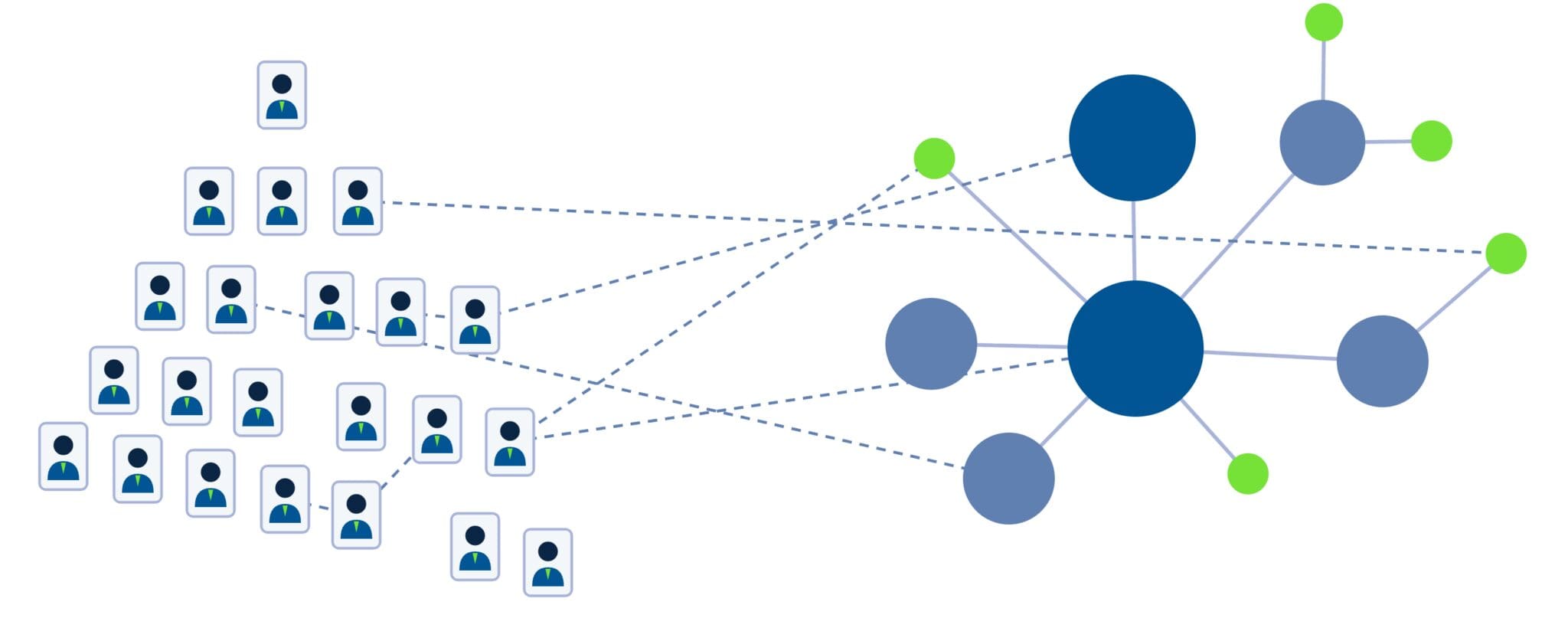
Dual operating system according to John P. Kotter
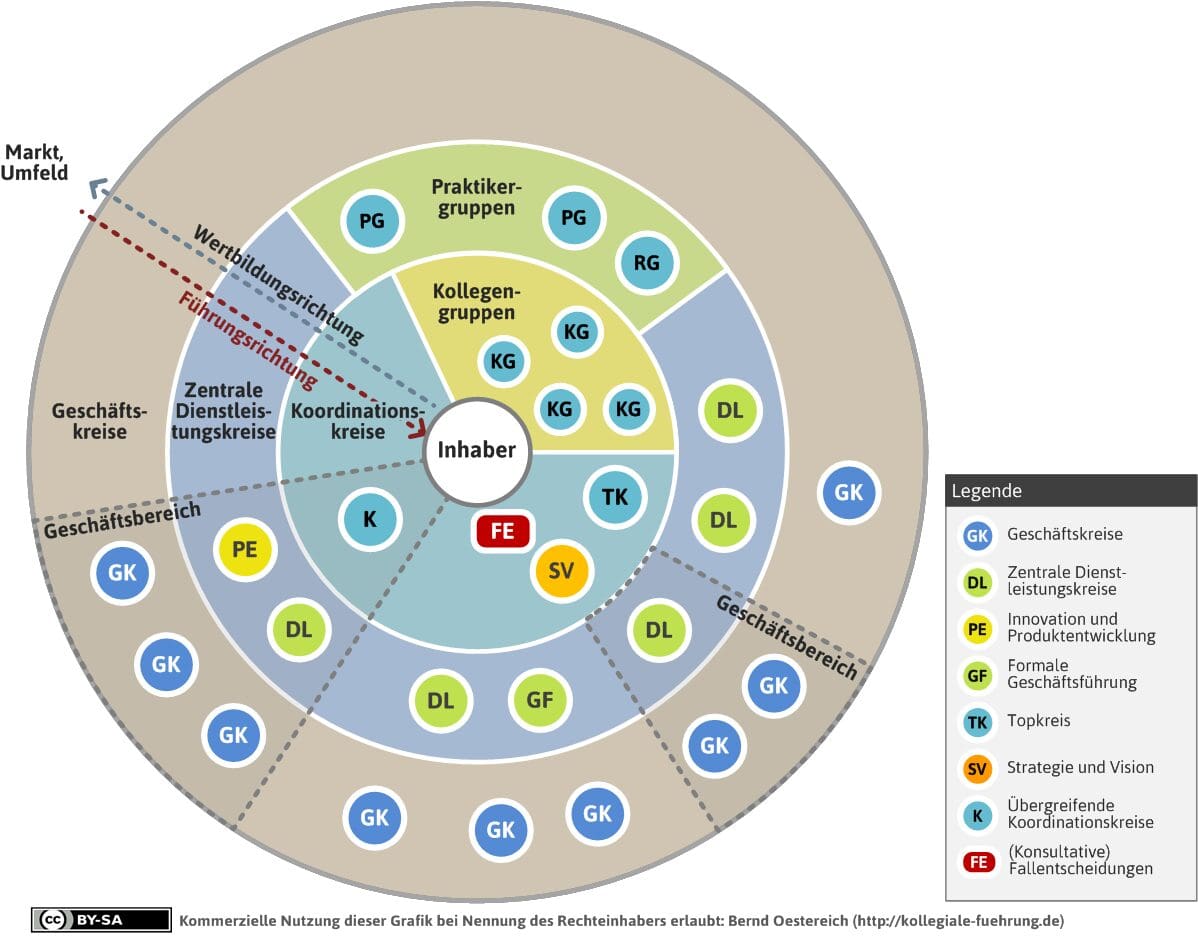
Agile circle organisation according to Oestereich / Schröder
Core elements of the new organisation
- Clearly defined value streams with identified customers
- Self-organised, cross-functional and cross-departmental value stream teams
- “Representatives” instead of team leaders: they decide directly in the regular communication
- Coordination circles resolve conflicts over goals and priorities
- Roles instead of functions, decisions by consent and integration of objections
- Separation of disciplinary and professional leadership
- Development teams form and dissolve according to customer needs – without lengthy reorganisation
- Transparent performance management of each circle via shop floor management boards
- Line managers develop into coaches
Approach
What we did together
Step 1
Reflecting on organisational forms
With the extended management team: comparing line hierarchy, value stream organisation and agile organisation – and deciding on a hybrid.
Step 2
Defining core value streams
A project team identified four major value stream areas and clarified the external interfaces. The focus shifted from internal processes to the customer.
Step 3
Redesigning the organisation
The operating model of the agile organisation was developed in workshops and tested against clear criteria for organisational design.
Step 4
Developing leaders
Two-day trainings on “Agile organisation and agile tools” made the target vision and tools understandable – enthusiasm for “going agile” grew.
Step 5
Large-group workshops
Open space and barcamp formats without a fixed agenda: participants set their own topics. All topics became improvement projects – the breakthrough to critical mass.
Step 6
Supporting the teams
Intensive team development for the new value stream and development teams. Because self-organisation does not mean leaving teams to their own devices.
Impact
Change on four levels
Employees
Full transparency on tasks and delivery performance. More decisions of their own and work in several teams.
Leadership
More time as a coach. Disciplined leadership at the Gemba: regular communication, decisions, go & see, problem solving, process confirmation, CIP.
Teams
Teams resolve conflicts over goals and priorities themselves – and use coordination circles when this is not possible locally.
Organisation
Neighbouring departments are involved. The new working system spreads because it is more effective – a cultural change across the whole company.
For top management this means: faster decisions in the system require more frequent strategy alignment – two workshop days at the start of the year for vision and annual goals, plus one day per quarter. Following the principle “tightly aligned, loosely coupled”.
Benchmark project result
The effort paid off
Strong improvement in all performance indicators: customer satisfaction, productivity, on-time delivery, quality and profitability.
The results of the benchmark project “Agile organisation in product development” at the car manufacturer speak for themselves.
In short: the company delivers faster, more reliably and more, with leaner leadership and lower costs.
Plus a clear boost in motivation – and a positive corporate culture. An agile organisation does not come for free: it needs continuous investment in cooperation and teamwork.
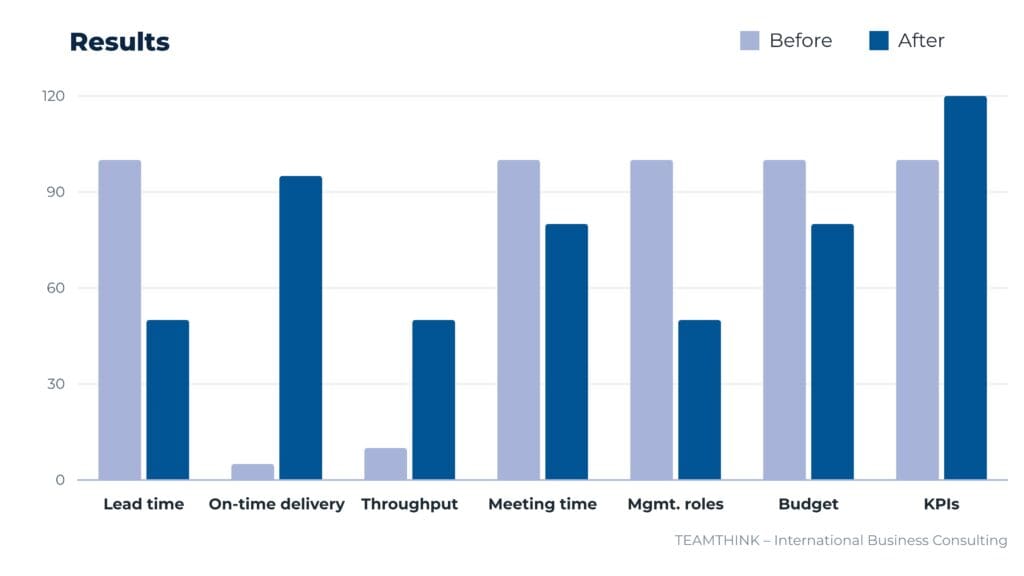
The results show a clear improvement in all areas. Lead time was halved. On-time delivery rose from 5 to 95 per cent: almost all deadlines are now met. Throughput increased fivefold.
At the same time, the effort is falling. Time spent in meetings dropped by 20 per cent, and the number of management roles by half. The budget is 20 per cent below the starting value.
Voice of the client
“TEAMTHINK supported us in the agile transformation of my department. Without their expertise and their ability to get people excited about the topic, we probably would not have made it from doing agile to being agile. Ultimately, TEAMTHINK are among the best agile coaches I know!”
Head of product development department, European car manufacturer
Is your department facing a similar task?
In a free strategy call, we will clarify where you stand and which next step makes sense.