
Case study · German mid-sized company
In flow from order intake to delivery
How a mid-sized industrial company viewed and redesigned its entire order processing – from the office to production – as one value stream, achieving top values in on-time delivery.
At a glance
Project profile
- Client: Mid-sized industrial company in Germany
- Industry: Mechanical engineering
- Size: 750 employees
- Topic: Optimising the entire order processing including production
- Methods: Value stream analysis and design, Makigami, Lean implementation
- Duration: 24 months
Starting point
Prices fall, costs rise – and nobody sees the whole process
Customers expect short delivery times, top quality and competitive prices. At the same time, wages, material and energy costs are rising. Anyone who wants to succeed in the long term has to cut lead time and costs and increase productivity.
Typical of mid-sized companies: production is already well organised, but days are lost between quotation, order entry, design, production planning, purchasing and shipping. This waste in the office is invisible – it is hidden in queries, idle times and handovers.
In this project, the goal was to increase on-time delivery and significantly reduce lead time across the entire order processing.
The approach
An order is a value stream – from the first customer contact to delivery.
In the office: Makigami
Administrative order processing is made visible step by step on the flipchart: who does what, with which document, for how long – and where errors, queries and waiting times arise.
In production: value stream analysis
Process, material and information flows are mapped from raw material to finished product. Inventories, waiting times and bottlenecks become measurable.
Approach
Five steps to the new value stream
Step 1
Learning to see
Learning the Lean basics and the types of waste – then a Gemba walk: the shop floor always tells the truth.
Step 2
Mapping the current state
Value stream mapping in production and Makigami in order processing: lead time, flow ratio, transfers and lost time are recorded.
Step 3
Marking improvements
Kaizen bursts show where action is needed. Detailed analyses such as set-up time analysis, spaghetti diagrams or work sampling go deeper.
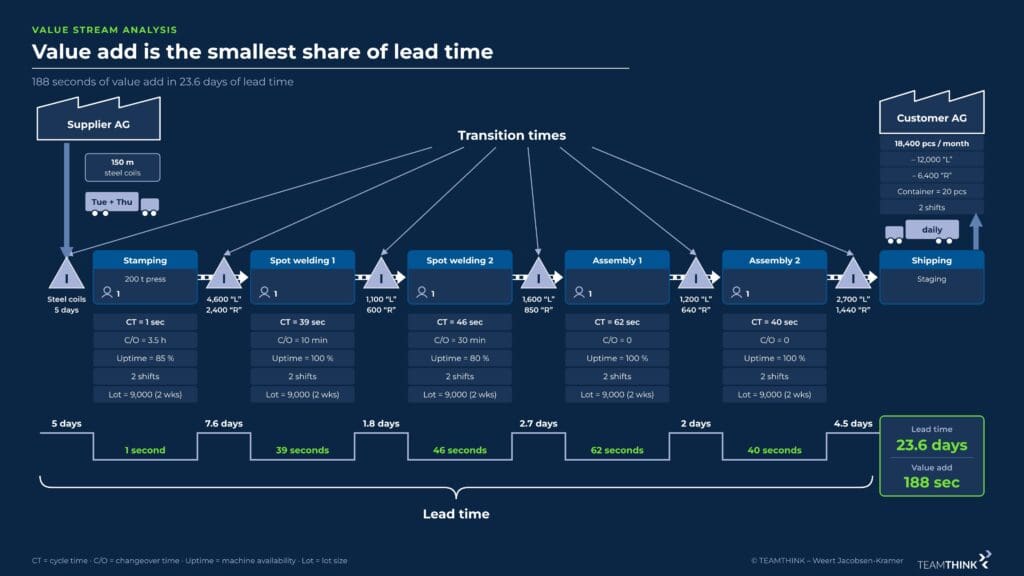
Value stream analysis and design in production
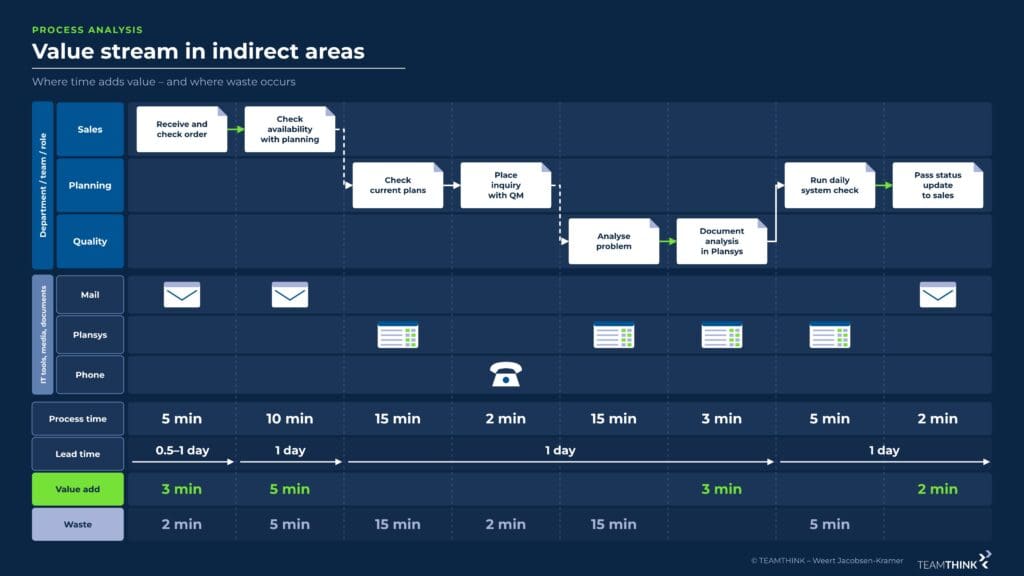
Makigami in administrative order processing
Step 4
Designing the target process
Value stream design and target Makigami based on the 5 Lean principles – with a conservative and a radical scenario. The result is a solution that guarantees a significant reduction in lead time and an increase in on-time delivery.
Step 5
Implementing with a Lean master plan
Various sub-projects are set up on the basis of a project charter including the targeted savings. The Lean master plan, combined with the tactical implementation plan and regular communication, ensures the project’s success.
Guardrails for the new process design
The 5 Lean principles
Value
Value is what the customer is willing to pay for. Everything else is waste.
Zero defects
Built-in quality, error prevention and structured problem solving with PDCA.
Flow
Linking process steps, minimising transfer batch sizes and idle times.
Takt
Customer takt sets the rhythm; fluctuations are levelled out (Heijunka).
Pull
Only what is needed is produced, when it is needed – controlled via Kanban.
Guardrails for training the team
THE LEAN HOUSE
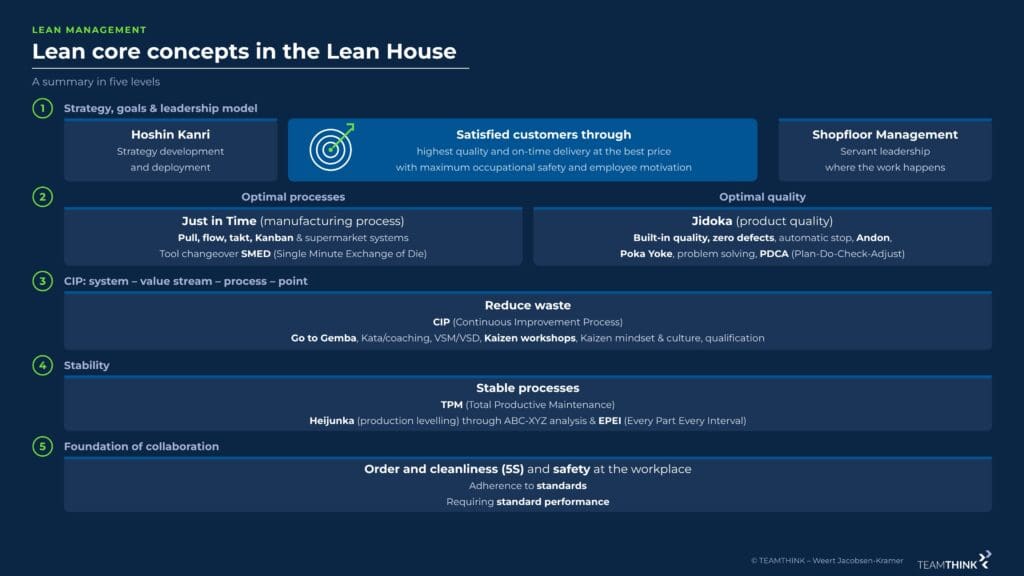
Lean house for teaching the core learning elements in the project.
Result
Shorter lead times, lower inventories, reliable delivery dates
After 24 months, the company works according to a shared value stream across its entire order processing, from quotation through design and production planning to shipping.
- Lead time: from order intake to delivery reduced from 40 to 25 working days
- On-time delivery: from 60% to 85% (on-time delivery from design to production planning from 50% to 90%)
- Inventories in production: reduced by 30%
- Savings achieved: €250k per year
- What else has changed: The teams in the office and in production now see their process as a whole. Queries and idle times become visible and are resolved every day instead of getting stuck between departments.
The Lean master plan ensures that improvements continue after the project ends. The internal Lean team continues to drive the changes together with the heads of department.
At the client’s request, the company’s name is not disclosed.
Where is your order processing losing time?
In a free strategy call, we will clarify where you stand and which next step makes sense – for example an on-site Quick Check.
More on the blog (in German): Value stream analysis & value stream design · The Makigami method · Lean house & 5 Lean principles