
Case study · Electrical engineering · Global Engineering
30% faster product development
How the global engineering organisation of an international generator manufacturer cut lead time in new product development by almost a third with hybrid project management and the Performance “U” – without restructuring the matrix organisation.
–30% lead time in new product development
At a glance
Project profile
- Client: Business unit of an international manufacturer of generators and electrical machines
- Area: Global Engineering, New Product Development
- Industry: Power generation, electrical engineering
- Approach: Hybrid project management, Performance “U”, shop floor management
- Duration: 24 months
- Result: –30% lead time in new product development
Starting point
Complex products, distributed teams, scarce experts
The business unit develops generators for a wide range of industrial applications – often customer-specific. Those who bring new products to market faster win orders.
Typical of a global engineering organisation in a matrix: many projects run in parallel, specialists are claimed by line managers and project managers at the same time and are often overbooked. Hardware, supply chains and test benches set hard limits – pure Scrum sprints don’t fit here. Commitments fall through, waiting times grow, lead time increases.
Solution, part 1
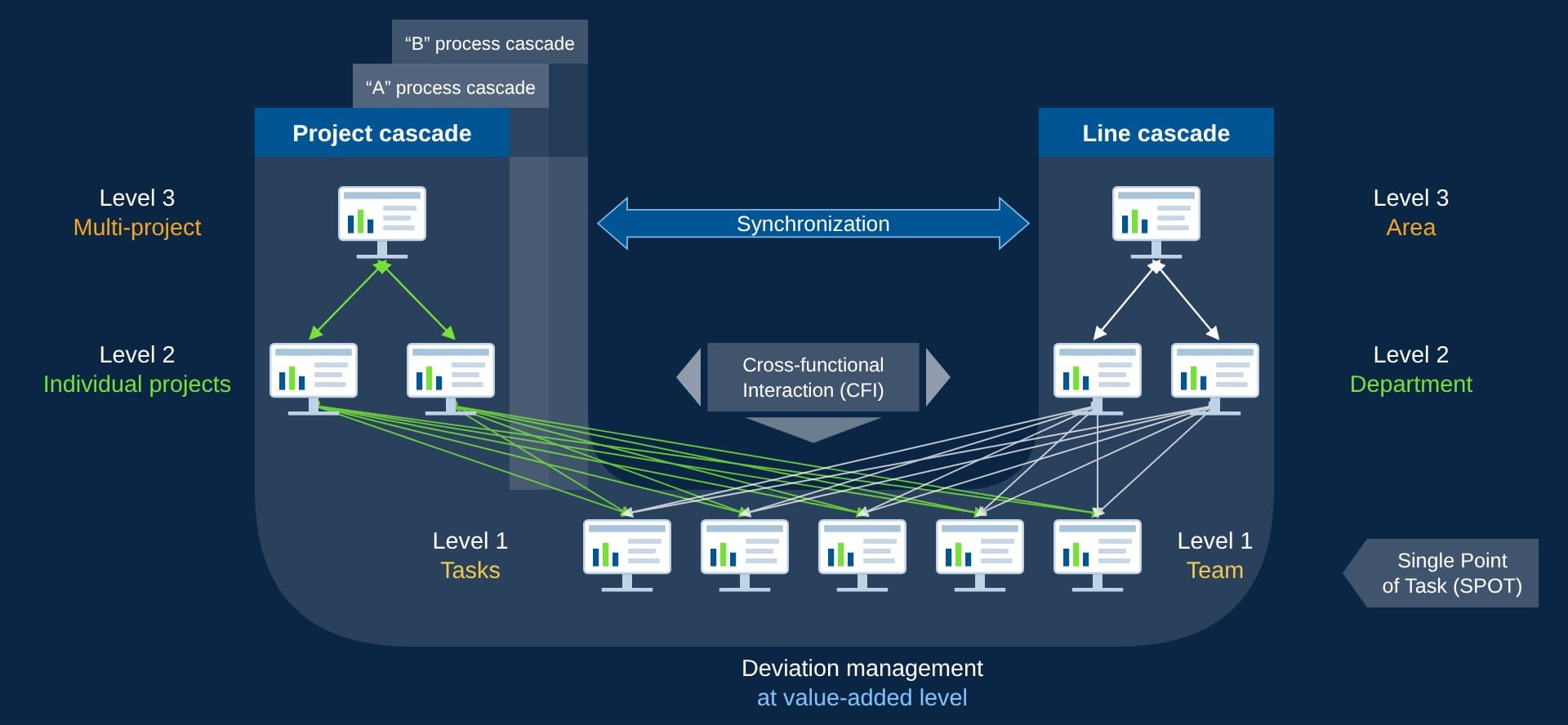
The Performance “U”: project and line in one cascade
Instead of restructuring the organisation, we connected the project and line hierarchy with the Performance “U” in a shared communication cascade – a model developed by Dr Andreas Romberg.
- Project side: All development projects on one board in multi-project management, steered weekly by the management team in around 30 minutes. The focus is on “what” by “when”.
- Line side: The specialist teams work through the work packages via team boards; leadership manages capacity and solves problems. The focus is on “who” and “how”.
- The project beats the line: Projects represent customer demand and take priority. The line follows.
- Single Point of Tasks: Each task is assigned to exactly one team – no duplicates.
- Planning at 80% capacity: According to queueing theory, lead time falls disproportionately when resources are not fully utilised.
- Multi-project management: Clear steering of projects in multi-project management instead of endless project reporting via PowerPoint presentations.
- governance: new governance rules steer collaboration in the new system.
Solution, part 2
Hybrid project management: plan reliably, steer with agility
Planning is maturity-based, in phases with quality gates. Steering is short-cycle and agile via shop floor management. “The more precisely you plan, the harder chance hits you.”
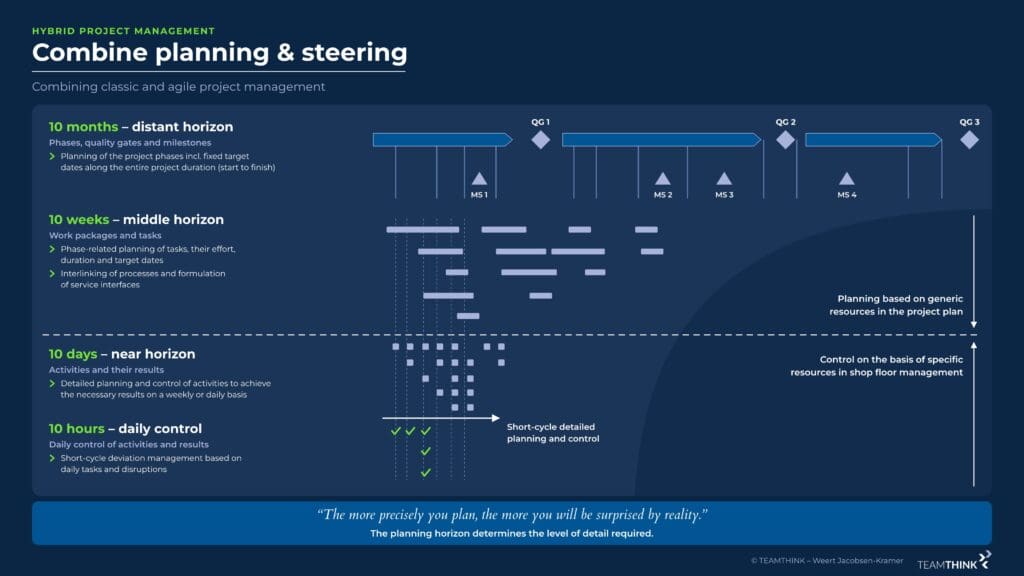
Rolling planning with the rule of 10
- 10 months – multi-project planning with milestones
- 10 weeks – project planning, dependencies continuously balanced
- 10 days – steering within the team, firmly scheduled
- 1 week – the takt of product development
Every week, the cross-functional project team reviews the previous week, firmly schedules the next two weeks and pre-plans weeks three and four. The specialist team leads balance the demands of all projects against their team’s capacity.
Rolling planning with the rule of 10
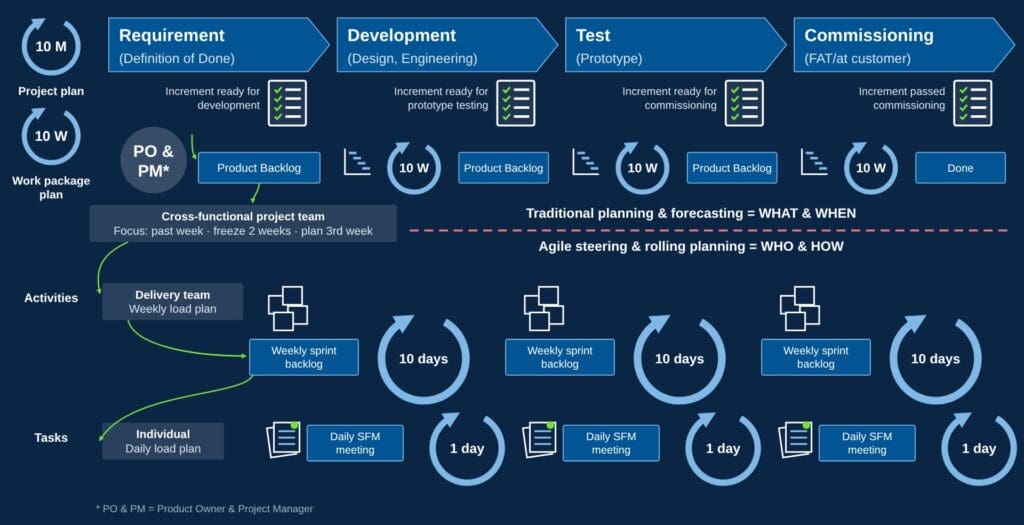
“Hikes” instead of sprints
In hardware development there are no disruption-free two-week sprints. That is why the teams work in “hikes”: continuous stages with clear intermediate goals. Four elements make this manageable:
1
Maturity levels with a definition of done for each development phase
2
Product Backlog with prioritised product increments
3
Hike Backlog with a target maturity level at the end of each stage
4
Hike Plan – linked tasks, dates and owners within the team
Hybrid steering: project demand (what by when) meets team capacity (who and how)
Solution, part 3
Digital shop floor management in engineering
Short regular communication
Visualisation on team and process boards and short, linked meetings in a cascade – from the team up to multi-project management.
Leading rather than lagging indicators
KPIs such as percent plan complete (PPC), on-time delivery, milestone analysis and first time right at the quality gate show risks while there is still time to take countermeasures.
Leadership where the work happens
Managers focus on the top issues, agree on go & see and resolve deviations in a structured way. This creates flow – and trust in the joint planning.
Digital shop floor management
Tervene
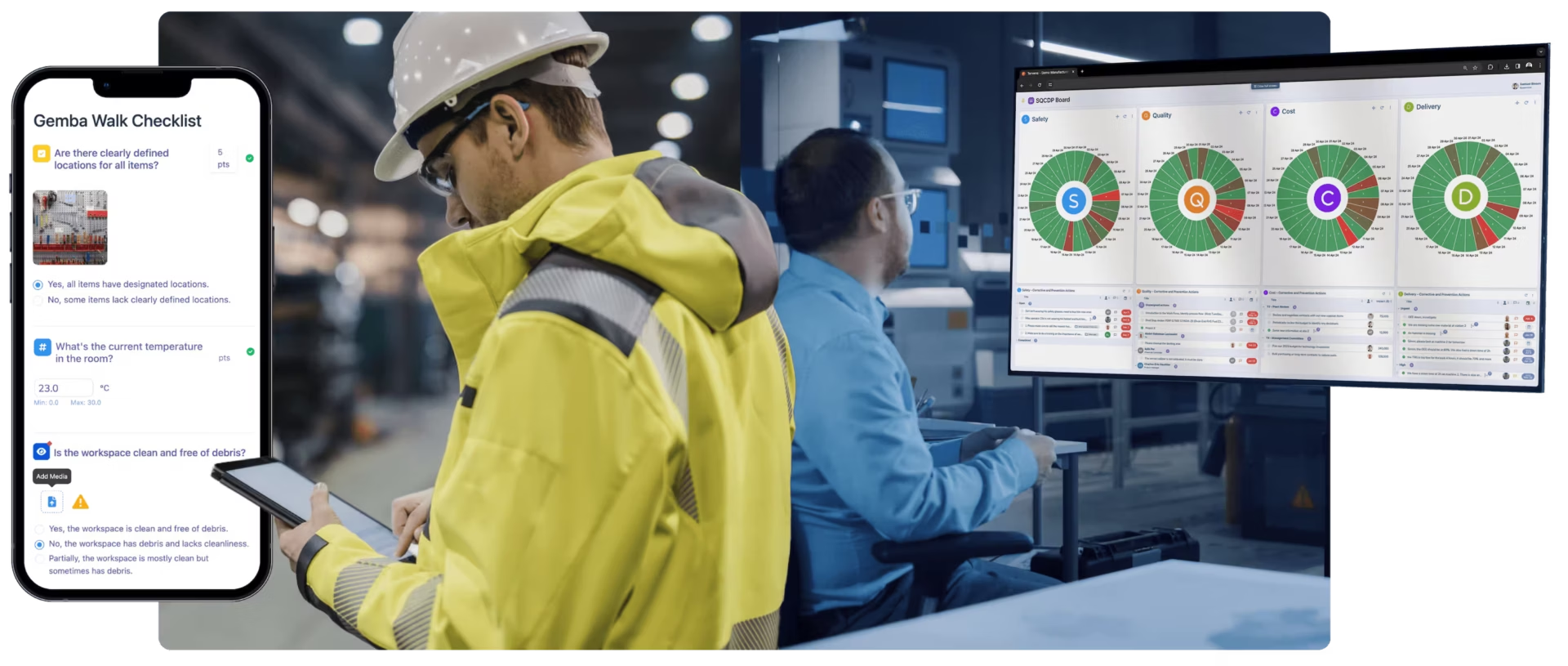
The client chose Tervene as its software for digital shop floor management in production and indirect areas. Tervene makes leadership routines binding, makes problems visible and keeps teams on track across shifts and sites.
The software provider from Canada offers a package of native applications for smartphone, tablet and desktop.
The software is delivered empty. TEAMTHINK supported the configuration of the system in order to establish the collaboration logic and method of the Performance U effectively in the software.
Result
Almost a third faster to market
–30%
The global engineering organisation reduced lead time in new product development by 30% – and achieved the change within the existing matrix organisation, without restructuring into an agile organisation.
At several sites in Europe and Asia, the engineers now work together transparently and effectively in the new digital collaboration performance management system. Deviations are detected early, resolved or escalated in a targeted way. Schedule adherence and throughput across the whole system are increasing.
Are your development projects taking too long?
In a free strategy call, we will clarify where you stand and which next step makes sense.
More on the methods on the blog (in German): Hybrid project management · The Performance “U”