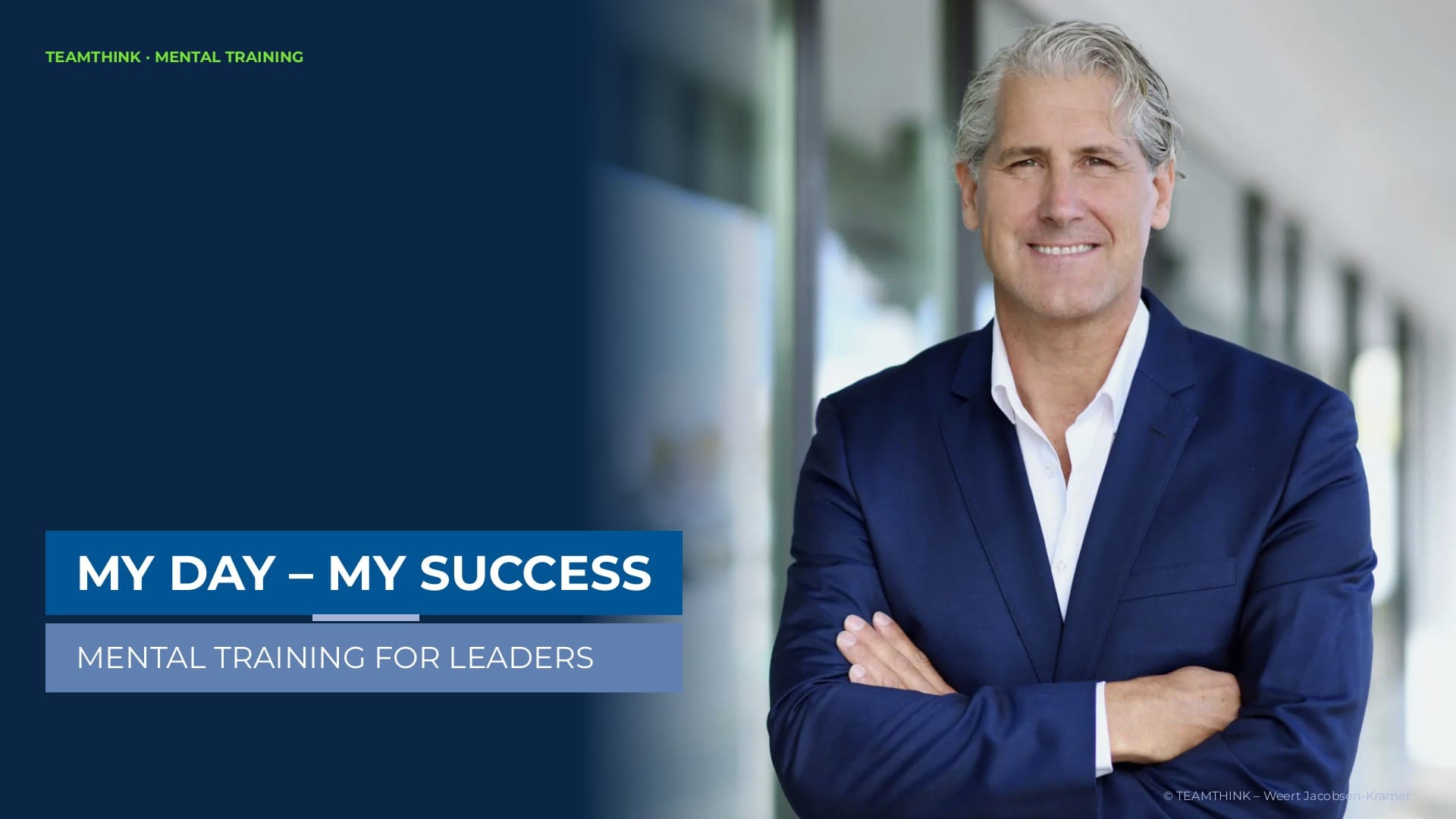
Leaders in times of change – part 2: my day – my success
In today’s dynamic business world leaders are constantly challenged to master complex challenges while inspiring and motivating their teams.
Mental training is a decisive factor that helps leaders optimise their skills, manage stress and develop a positive attitude.
In this article we look at what mental training for leaders involves and how it contributes to success, happiness and fulfilment .
This is the second part of our series “Leaders in times of change”. Part 1 (in German) is about how personal change succeeds in six steps.

“Mental training is the key to success, happiness and fulfilment.”
– Weert Jacobsen-Kramer
The importance of mental training
Mental training aims to strengthen the mental and emotional abilities of leaders. It is based on techniques that promote mental clarity, emotional stability and a positive attitude to life. These abilities are essential for staying calm in stressful situations, making effective decisions and increasing well-being.
What are success patterns?
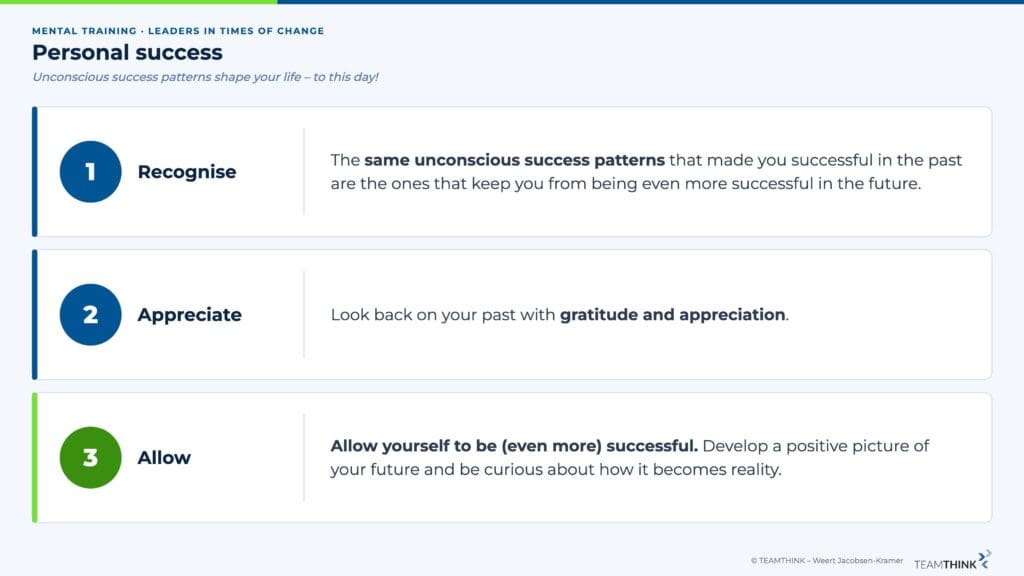
If we want to understand success, we have to internalise that it is the same unconscious success patterns that made you successful in the past, that keep you from being even more successful in the future.
All learning takes place on an emotional level in the brain. There, response patterns to situations are learned through repetition. Every pattern is therefore always a success pattern, because it was learned as a positive response to a situation.
Unfortunately, patterns that in the past were an important and correct solution often no longer represent a suitable solution in the current situation. For example, the typical pattern “I have to try hard!” is not a good pattern for solving problems or conflicts.
How can I change existing patterns or learn new ones?
Many people make a crucial mistake. They treat themselves reproachfully and critically . That is a dead end. The more I get annoyed with myself, the more I remain stuck in the old pattern – and even strengthen it.
The solution is simple: look with gratitude and appreciation at your past and your own patterns. Allow yourself to be (even more) successful! Allow yourself to let new patterns in and let them emerge . Develop a positive picture of the future for yourself and be curious about how it becomes reality.
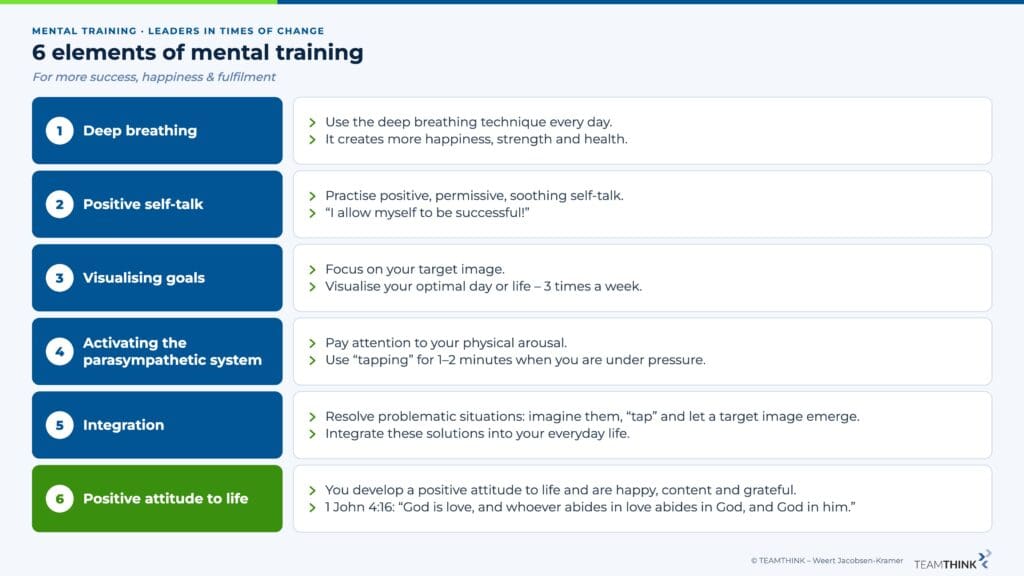
The six elements of mental training
Mental training for leaders can be divided into six central elements that together bring about a holistic improvement in mental strength and resilience. For more than 10 years I have been using this method of mental training with great success.
Deep breathing
- Technique: Regular deep breaths to calm the mind and relax the body.
- Benefits: Reduces stress, improves concentration and promotes a sense of well-being.
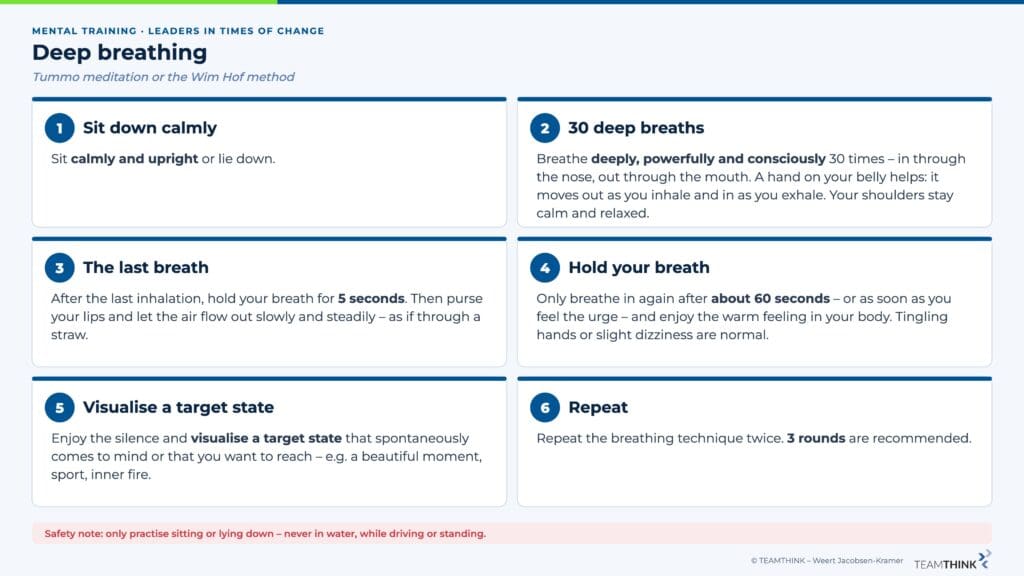
The deep breathing method has become well known in recent years through Wim Hof .
Tummo roughly translates as ‘inner fire’ and is, broadly speaking, an ancient meditation technique from Tibet. It consists of a special breathing technique and the visualisation of an “inner fire”.
Tibetan monks are able to raise their body temperature by 8 degrees with it. They meditate without clothing in the snow.
The biggest advantage is that, with regular practice, the breathing technique can raise your body temperature in the long term. This in turn can have massive positive effects on your digestion, your immune system and your sensitivity to heat and cold.
In the short term, the breathing technique leads to better blood circulation and oxygen supply, inflammation should spread less in your body, the number of mitochondria – and with it your energy potential – is likely to rise sharply, and a feeling of a clear, alert and focused mind sets in. The result is more happiness, strength, health.
Deep breathing can be combined very well with cold exposure . This enhances the effect of deep breathing.
Positive self-talk
- Technique: Fostering a positive inner voice that strengthens encouragement and self-confidence.
- Benefits: Increases self-esteem and motivates proactive action.
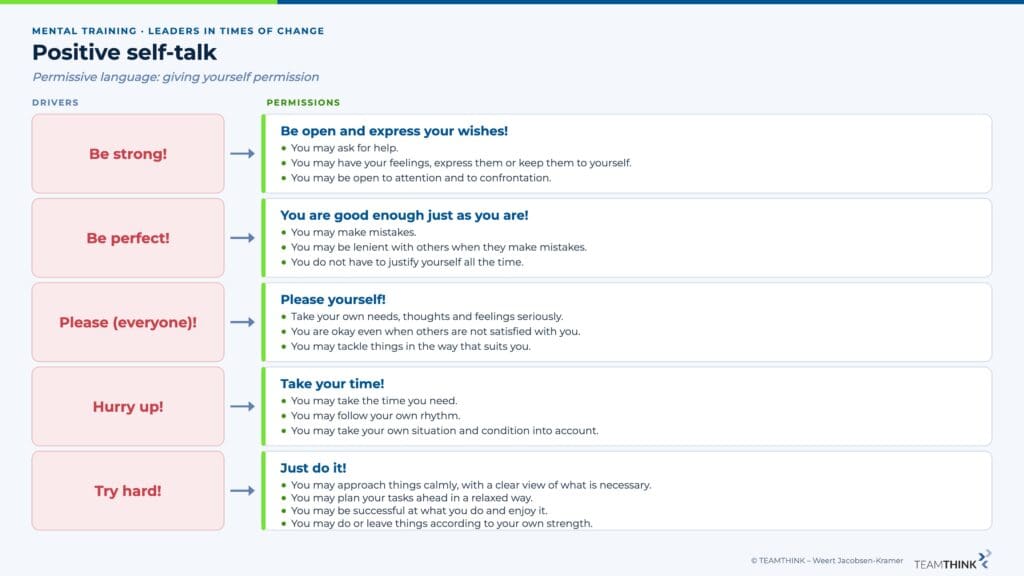
In childhood, people develop a combination of belief and behaviour patterns, which significantly influence behaviour, thinking and feeling in adulthood. These patterns are a reaction to the perceptions of that time. Today’s adult is no longer aware of them.
In stressful situations these patterns have a particularly strong effect. Under stress, people reach for familiar patterns from their childhood. They react to today’s ‘threats’ with behaviour and emotions from their childhood. The patterns of the past act as inner drivers and are sometimes not helpful.
In mental training, the client learns to replace the inner drivers with positive self-talk.
Visualising goals
- Technique: Daily visualisation of target images and desired results.
- Benefits: Sharpens focus, increases motivation and helps to achieve clearly defined goals.
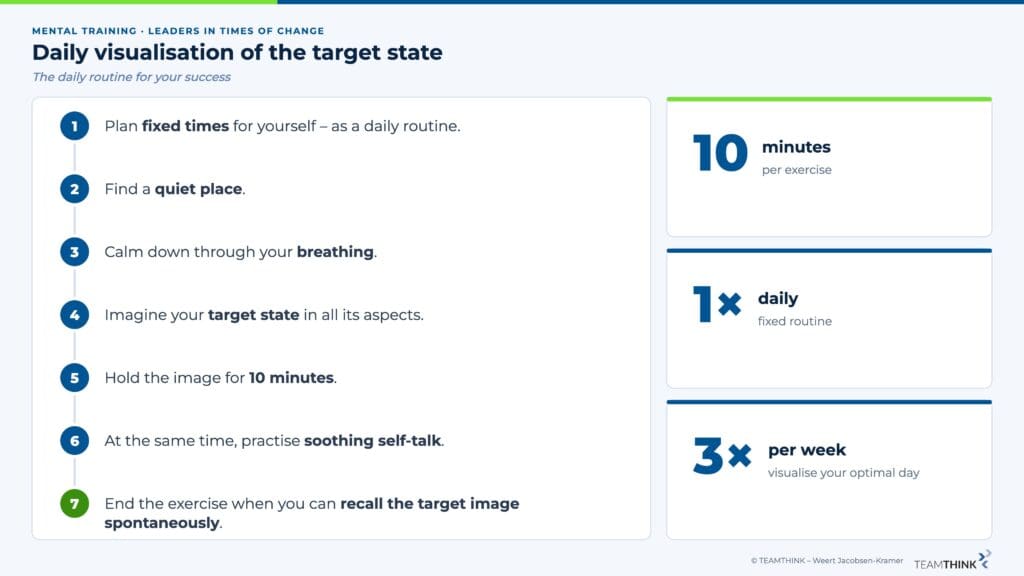
To make daily routines effective, it is important to plan fixed times for yourself. Find a quiet place where you will not be disturbed. Start by calming down through your breathing . Then visualise your desired target state in every detail. Hold this image for about 10 minutes while practising soothing self-talk. Only end the exercise when you can recall the target image spontaneously and effortlessly.
Activating the parasympathetic nervous system
- Technique: Using relaxation techniques such as tapping to activate the “rest nerve”.
- Benefits: Promotes relaxation and regeneration and improves emotional stability.
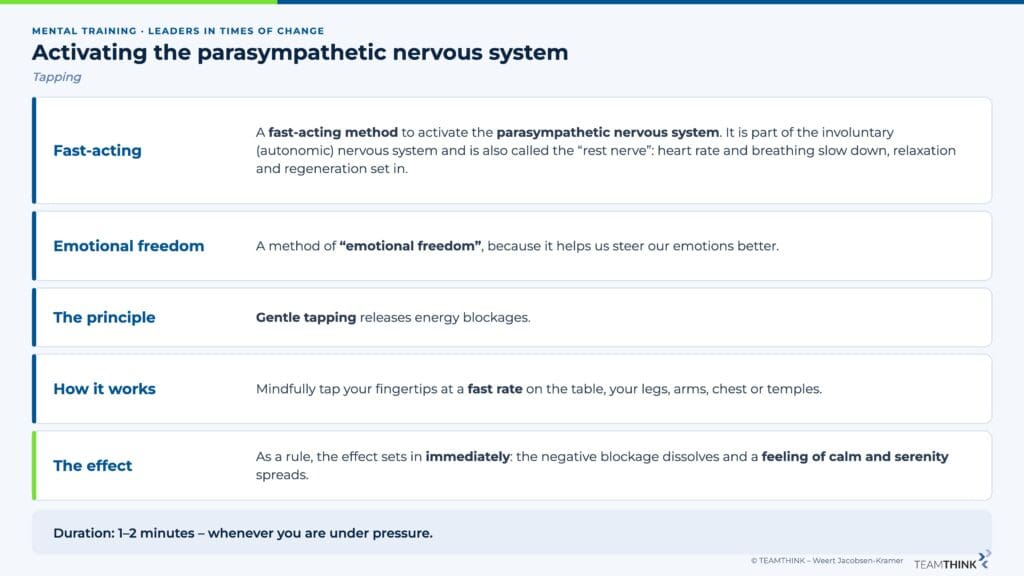
A fast-acting method to activate the parasympathetic nervous system is mindful tapping. The parasympathetic nervous system is part of the involuntary (autonomic) nervous system and is also called the “rest nerve” . Among other things, it slows heart rate and breathing, which leads to relaxation and regeneration. This method promotes “emotional freedom”, because it helps us steer our emotions better.
The principle of this technique is to release energy blockages through gentle tapping. How it works: You tap your fingertips at a fast rate on the table or on your legs, arms, chest or temples. As a rule, the effect sets in immediately: the negative blockage dissolves and a feeling of calm and serenity spreads.
Integrating solutions to problems
- Technique: Visualising and putting into practice solution strategies for existing problems.
- Benefits: Strengthens problem-solving skills and integrates positive changes into everyday life.
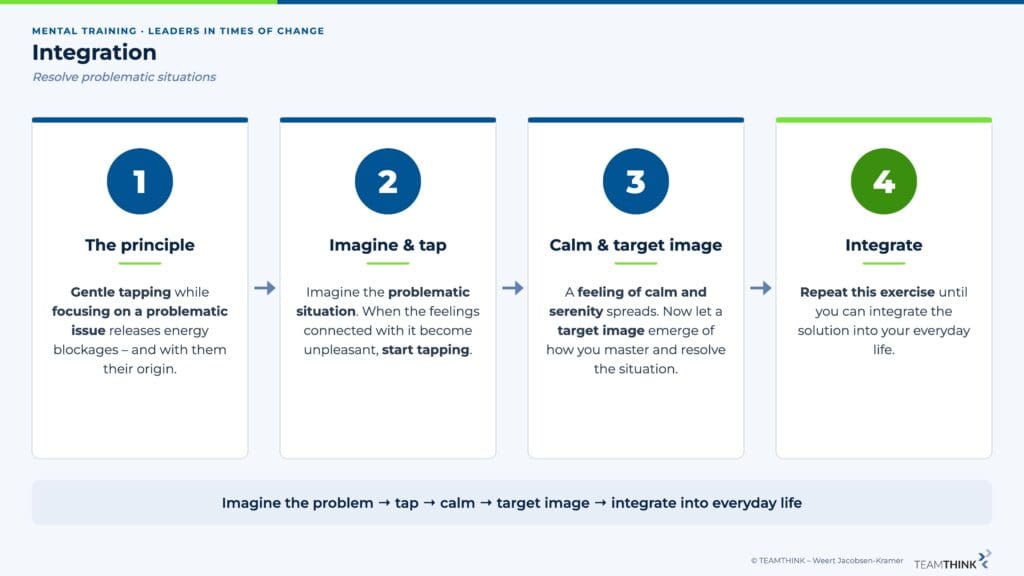
By tapping gently while focusing on a problematic issue, energy blockages and their origin can be released. How it works: imagine the problematic situation . When the feelings connected with it become unpleasant, start tapping. A feeling of calm and serenity spreads. Now let a target image emerge of how you master and resolve the situation. Repeat this exercise until you can integrate the solution into your everyday life.
Developing a positive attitude to life
- Technique: Focusing on gratitude, love and positive thinking.
- Benefits: Promotes happiness, contentment and an optimistic outlook on life.
Developing a positive attitude to life means being happy, content and grateful. This inner attitude affects not only your own well-being but also your environment and your relationships with others.

An inspiring source for this positive attitude can be the Bible verse 1 John 4:16: “God is love, and whoever abides in love abides in God, and God in him.” This verse reminds us that love is the foundation of a fulfilled and harmonious life. Those who focus on love and live it in their everyday lives find contentment and inner peace.
But love can be found not only in God, but also in many other things that matter to us as human beings, e.g. sport, music, dancing, being in nature.
Gratitude is another key to a positive attitude to life. Those who appreciate the small and big gifts of life develop an optimistic outlook and can master challenges more easily. Being happy often means recognising the positive aspects of every situation and making the best of it.
All in all, a positive attitude to life leads to more joy, better relationships and a deeper sense of fulfilment. It is a conscious decision to see life from a loving and grateful perspective, which leads to a happier and more contented existence.
Putting mental training into practice
Implementing mental training in a leader’s everyday life is crucial to its success. Here are some proven ways to integrate these techniques into your daily routine:
- Daily routines: Plan fixed times for mental exercises such as deep breathing and visualisation.
- Reflection and adjustment: Regularly take time to reflect on your progress and make adjustments.
- Seek support: Use coaching and mentoring to deepen and continuously improve your mental training.
Conclusion
Mental training is a powerful tool that helps leaders optimise their skills and achieve their professional and personal goals.
By integrating the six elements of mental training, leaders can not only increase their performance but also lead a more fulfilled and contented life.
If you would like to learn more about mental training and its benefits, visit our website or join our upcoming “My day – my success” coaching event.
If you would like to discover effective mental training for yourself, please get in touch with me. I will show you how mental training can help you, too, to achieve success, happiness and fulfilment .
Agenda: My day – my success
Your coaching day with Weert Jacobsen-Kramer
| Time | Content |
|---|---|
| 08:00–09:00 | Welcome & clarifying the goals for the day |
| 09:00–09:30 | Exercise: deep breathing |
| 09:30–10:00 | Defining the target image “My day – my success” |
| 10:00–10:30 | Exercise: positive self-talk |
| 10:30–11:30 | Mental training I: visualising the target image |
| 11:30–12:30 | Exercise: activating the parasympathetic nervous system |
| 12:30–13:30 | Lunch break |
| 13:30–15:30 | Mental training II: resolving a problem situation |
| 15:30–17:00 | Mental training III: integrating the target image |
| 17:00–18:00 | Summary & close |
| 18:00–20:00 | Dinner |
About the author
Weert Jacobsen-Kramer studied psychology at Kiel University. While still a student, he qualified as a systemic consultant and developed a great passion for water sports, especially sailing. This passion led to his first profession as a professional sailor, in which he was, among other things, one of the first Germans to take part in the America’s Cup.
After his sports career, Weert Jacobsen-Kramer completed further training as a systemic consultant and coach at the Institut für Systemische Studien in Hamburg. He also completed training in hypnotherapy at the Milton Erickson Institute in Hamburg with Ortwin Meiss and training in the LIFT method according to Karl Josef Sittig.
For 25 years now, Weert Jacobsen-Kramer has been working as a management consultant, trainer and coach in international change projects and in executive coaching for companies. He is an experienced management consultant, executive coach and expert in mental training.
For years he has been accompanying high performers on their way to lasting success. As mental coach at the Olympic training centre Kiel/Hamburg, he developed his own approach to mental training for leaders.
Get in touch now!
Mental training for your leadership team
Arrange a no-obligation conversation.
We discuss the current situation in your company and your leadership team.
The training is tailored precisely to your leadership team.
Choose an appointment right here.
Our offer is aimed exclusively at companies.
Prefer email? Write to us at mail@teamthink.de.