Value stream mapping & value stream design
What is value stream mapping and what is value stream design? Why is value stream mapping the method of choice in consulting? Why is change necessary at all? How exactly does value stream mapping work? What do “go to gemba” and “go & see” mean, and what is a “sensei”?
This article answers all these questions. We hope you enjoy reading it and find it an interesting learning experience!
Summary
- Value stream mapping is the central tool in lean consulting.
- Value stream mapping looks at one or more core processes or core value streams through which the company creates its central value.
- As a rule, the entire process flow, material flow and information flow from raw material to finished product is analysed.
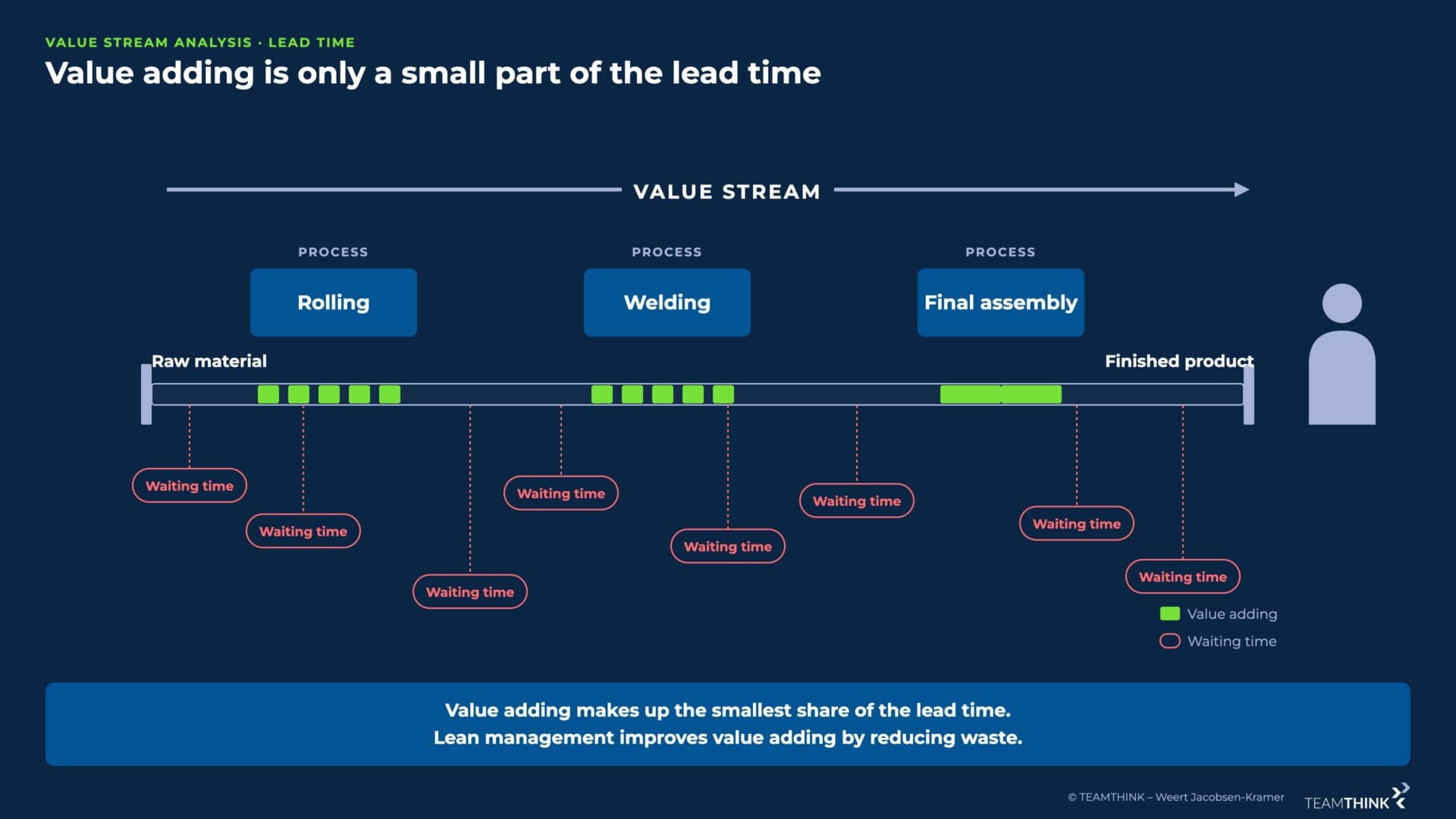
- It determines how long it takes for a product to pass through the process until it is finished. The lead time is a key metric in lean management.
- Value creation refers to all activities on the product that increase its value from the customer’s point of view . Waste by this definition, is every other activity, such as transport, handling, storing and retrieving, queries and so on.
- The value creation in the process is separated from waste and the main problems and disruptions in the process are identified.
- Since value creation makes up the smallest share of the lead time, consulting focuses above all on reducing waste rather than primarily on optimising the value-adding parts of the process.
- The aim of value stream mapping is to use value stream design to develop a new, better process with a shorter lead time.
- On the basis of this value stream design, lean projects are defined to reach the new value stream.
- These projects are tracked as part of a lean transformation in the lean master plan .
Why is change necessary? Prices fall – costs rise!
Value stream mapping always starts with the question of why change should happen at all. Usually the situation in the company is still reasonably satisfactory. There are warning signs, but the people in charge do not yet feel any real pressure to change.
It then helps to show once more why change, and explicitly cost reduction projects , must be an essential part of a healthy company.
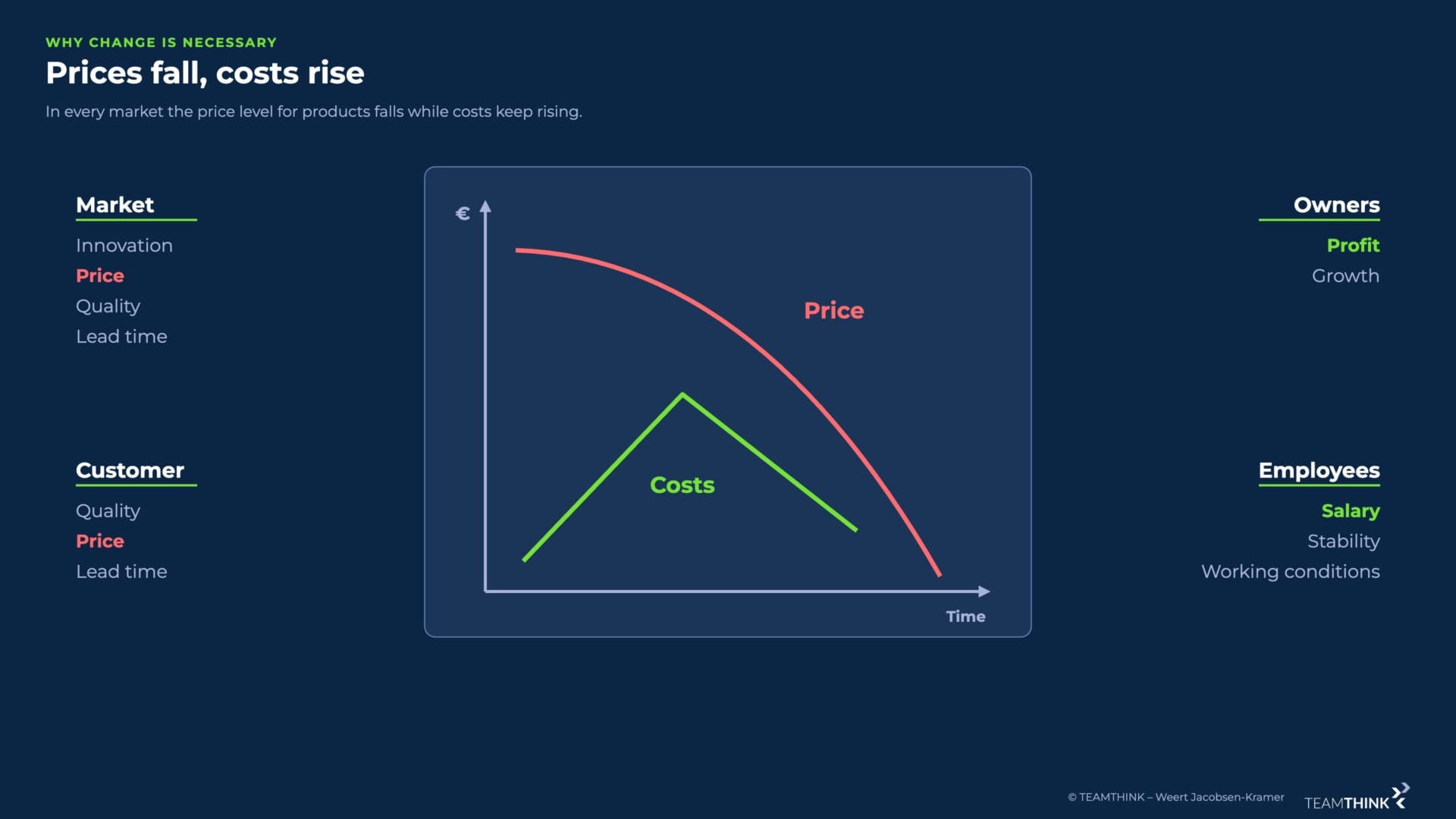
While the market and customers want to pay ever lower prices for an innovative product (with the best quality and a short lead time), the owners and employees demand ever higher profits and rising salaries.
Every company therefore faces the conflict between rising costs and falling prices. This is why, at some point, every company is forced to reduce costs and increase productivity.

This dynamic is easy to see in the example of the automotive industry . This older study by the Massachusetts Institute of Technology, USA, shows the considerable differences in productivity between American, European and Japanese car makers. Market dynamics demand constant improvement of manufacturing processes from every player.
Go to gemba – genchi genbutsu
There is no more instructive, more honest place than the gemba – the shop floor, the place where the work happens. Because the shop floor always tells the truth. The nature of a company shows in the way its shop floor is organised.
That is why it is so important to spend time on the shop floor. Anyone who can read the shop floor recognises a company’s strengths and challenges.
In the lean world we say “go to gemba”, which comes from the Japanese term “genchi genbutsu” . Literally it means “real place, real thing” and is a key principle of the Toyota Production System.
The principle is also called “go & see” “walk and look”. It means that all management processes must aim to simplify the process of value creation on the shop floor. That is why managers in the Toyota Production System are expected to “go” to the shop floor and “observe” how the process of value creation can be improved.
The sensei
A lean sensei is an expert in lean managementwho helps companies implement more efficient processes. The Japanese term “sensei” translates as “teacher or master” and is also used as a form of address.
A sensei is a lean expert with particularly extensive experience and/or industry know-how who is able to guide clients through the difficult terrain of lean transformation projects .
A sensei looks not only at the technical topics of the transformationbut also places a strong emphasis on developing the leadership skills of managers.
Value stream mapping – central method
Value stream mapping (VSM, also called value stream analysis, VSA) is the central method in lean consulting. The core value-creating processes are analysed with the aim of reducing or eliminating waste in order to shorten the lead time. The goal is to develop a better process through a new value stream design (VSD).
Value stream mapping is also seen as the central method because both clients and lean consultants get to know the company very well through it. Value stream mapping is usually the starting point for a longer lean transformation. Value stream maps are later repeated again and againto eliminate even more waste from the process.
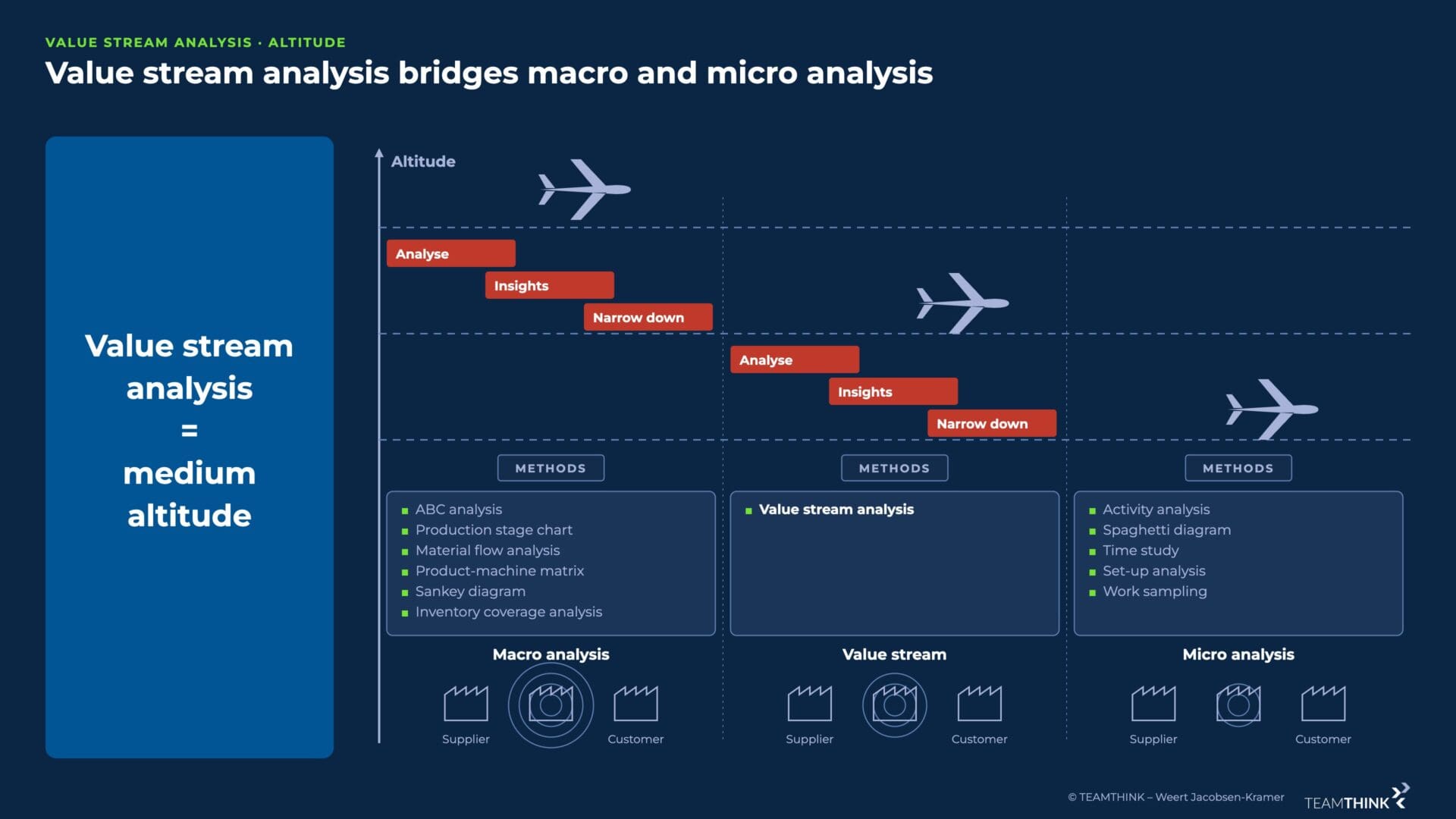
Value stream mapping bridges the macro and micro analysis of a company. It tries to reflect the reality of the value stream as closely as possible. It is an approximation of reality. No value stream map can reflect reality perfectly, because reality is constantly changing. So this is not a hard science, since we can only ever look at, record and analyse a snapshot of the company.
An approximate picture of the entire value stream is enough to identify the core problems in the value stream and take countermeasures.
The detailed analyses and detailed solutions can follow selectively, afterwards, in kaizen workshops .
Value stream mapping creates complete transparency
Value stream mapping is a positive learning experience for participants, because we can experience lean management in practice . The lean principles and tools are applied to a concrete value stream and produce results immediately.
For those involved, value stream mapping can be a difficult experience because all challenges in the value stream become transparent .
We use this new transparency to achieve improvement in the future rather than looking for someone to blame. That would be waste. Employees always try to achieve the best results in the interest of the company – in the past, in the present and in the future.
On the one hand, the role of consulting is to create transparency and work out the challenges, because without transparency no progress can be made. On the other hand, the consultants appreciate the client system for the solutions it has found so far.
“No progress can be made if we are satisfied with the current situation.”
– Taiichi Ohno
The workshop: value stream mapping & design
The following describes a typical value stream mapping & design workshop. A workshop usually takes 5 days and follows this agenda:
| Monday | Tuesday | Wednesday | Thursday | Friday |
| Start | Morning round | Morning round | Morning round | Morning round |
| Lean basics | Product/process matrix | Calculation of flow factor / lead time | 5 lean principles | Calculation of cost savings |
| Gemba walk | Value stream mapping – process flow | Kaizen blitzes | Value stream design | Lean master plan |
| Definition of challenges | Value stream mapping – material flow | Analysis of the cost structure | Definition of lean projects | Next steps |
| Lean analysis methods | Value stream mapping – information flow | Further analyses* | Benchmark solutions | Wrap-up |
| Wrap-up | Wrap-up | Wrap-up | Wrap-up |
*Set-up time analysis, spaghetti diagram, chalk circle, work sampling, etc.
Workshop goals
- Mapping the value stream
- Working out the challenges
- Deriving the new value stream design
- Agreeing on a lean master plan with defined sub-projects
- Estimating the cost savings per sub-project
- Training workshop participants in important lean concepts
Value stream mapping and design – day 1
Day 1 of value stream mapping is first about getting to know each other, and about teaching basic knowledge of lean management .
The consultants explain why change is necessary at all and explain the QCD triangle and the lean house with its various aspects.
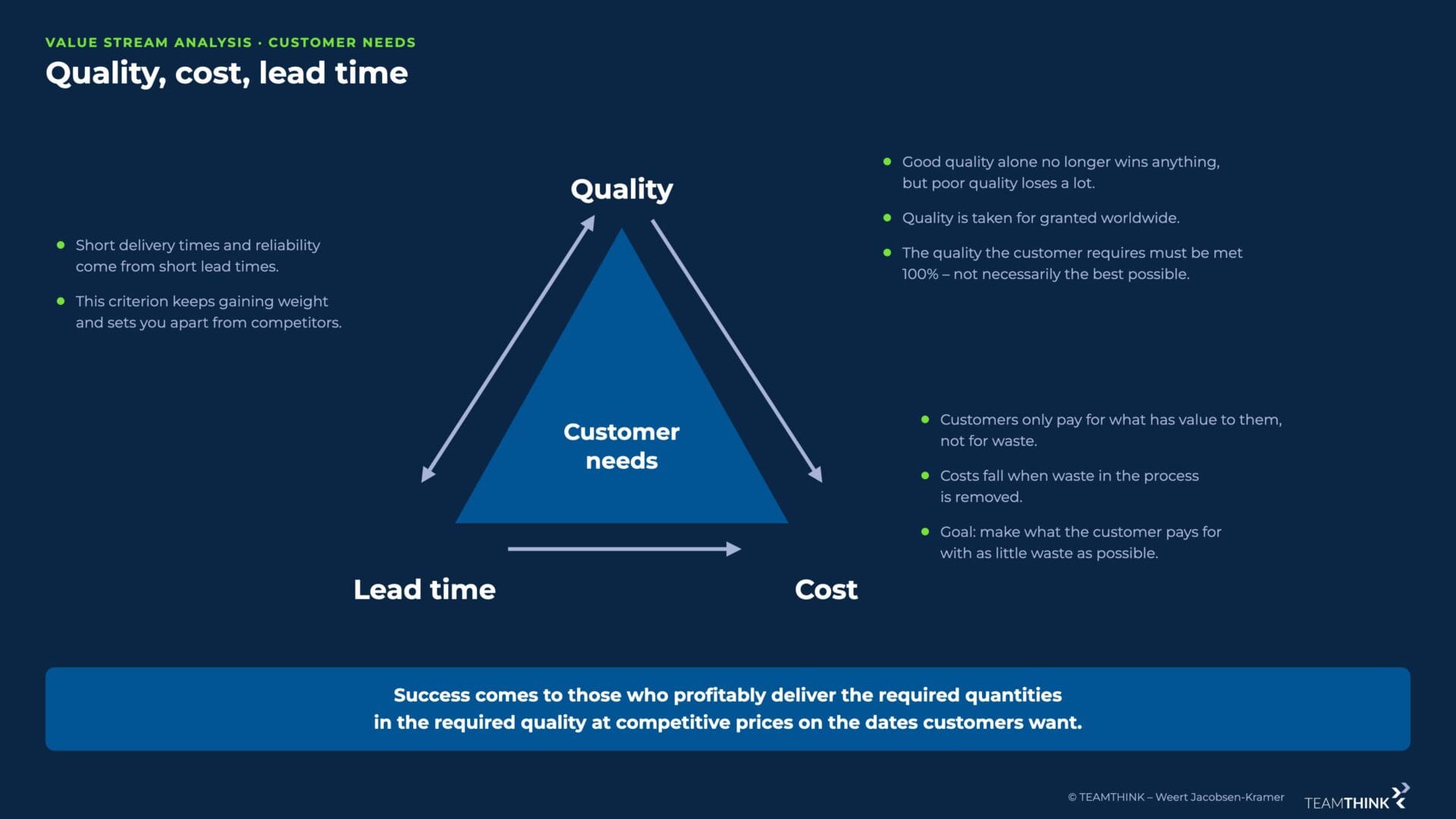
The QCD triangle essentially states that companies are successful when they deliver the product to the customer on the requested date, in the required quantity and quality, at a competitive price. In particular, the relationship between inventory and lead time is discussed, leading to the conclusion that in lean management we force and generate continuous improvement by shortening the lead time.
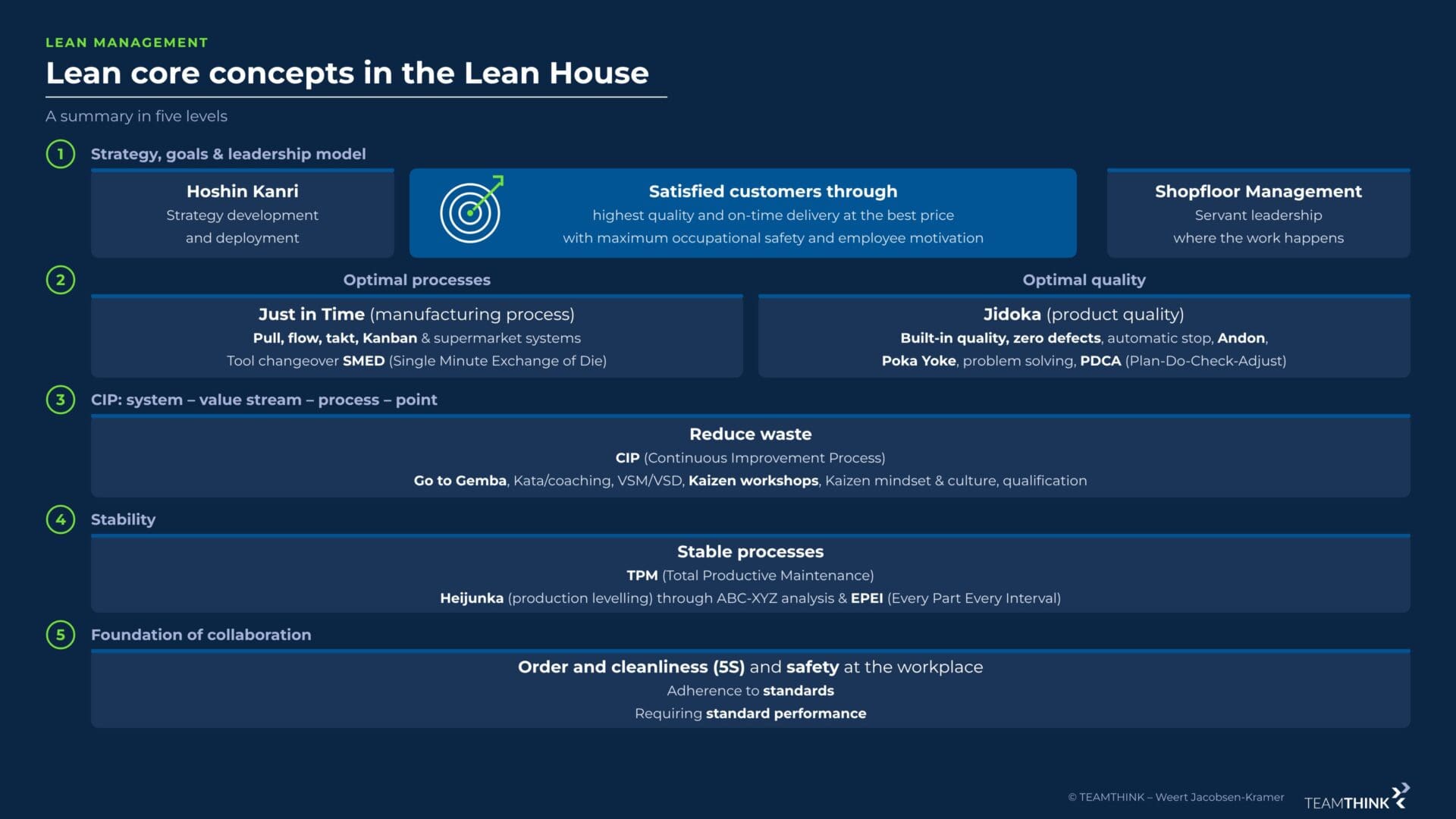
The lean house is essentially based on the two pillars of the Toyota Production System.
The concept of just-in-time covers the principles of takt, one-piece flow, pull/kanban and the concept of quick tool changes (SMED).
The concept of jidoka covers the principles of the zero-defect strategy, built-in quality, intelligent automation or autonomation with an immediate production stop, as well as poka-yoke and the PDCA cycle for structured problem solving.
The base of the lean house consists of occupational safety, order and cleanliness, standard work and visual management. On this basis, stability can be achieved through Total Productive Maintenance (TPM) and smoothed and levelled production (heijunka) .
The status quo is continuously optimised through further reduction of waste and process improvement, coaching in the process, process analyses and established shop floor management .
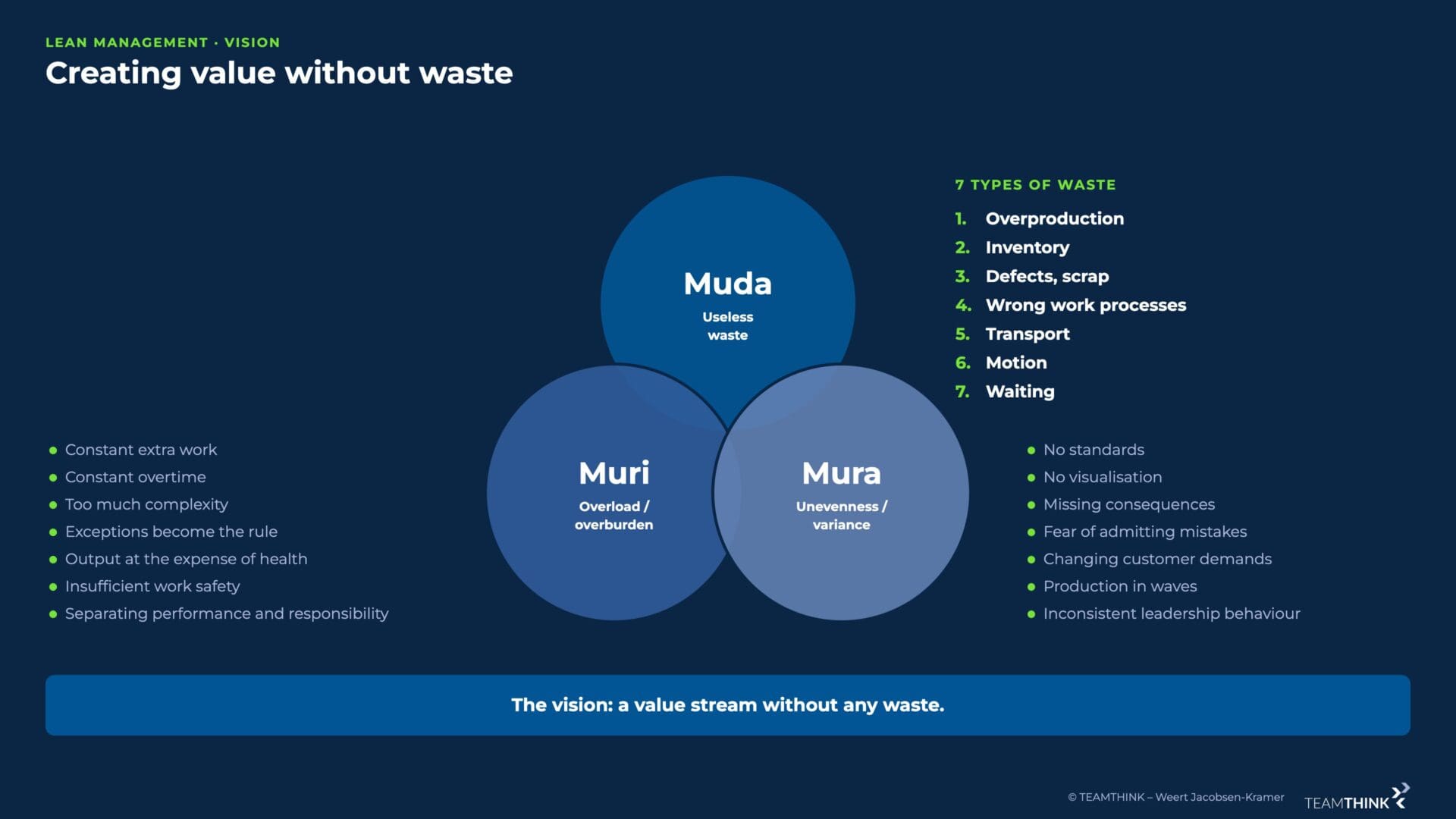
Another important element explained is the concept of muda (waste), muri (overburden) and mura (unevenness) . The 7 types of waste are usually already known and are illustrated once more with examples.
In the afternoon, the group, now sensitised by the new knowledge, naturally goes onto the shop floor for a gemba walk. The aim of the first gemba walk is to understand the process and define waste/challenges.
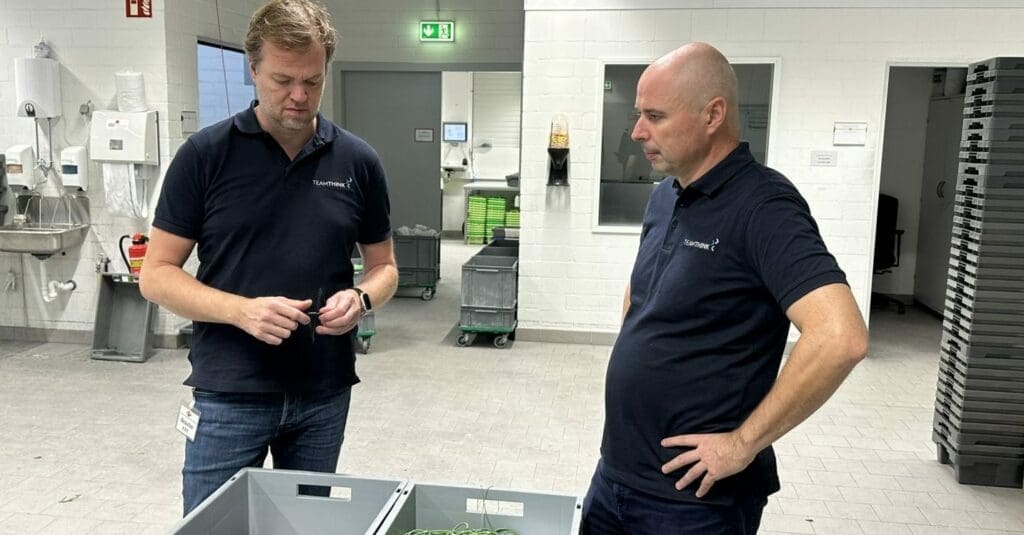
The observations are then collected and visualised together in the group and discussed in the team. This creates a shared, realistic understanding of the situation, and the first day ends.
Value stream mapping and design – day 2
After a morning round reflecting once more on important aspects of the previous day, the consultants analyse the product/process matrix and decide together with the client on the selection of the value streams to be examined.
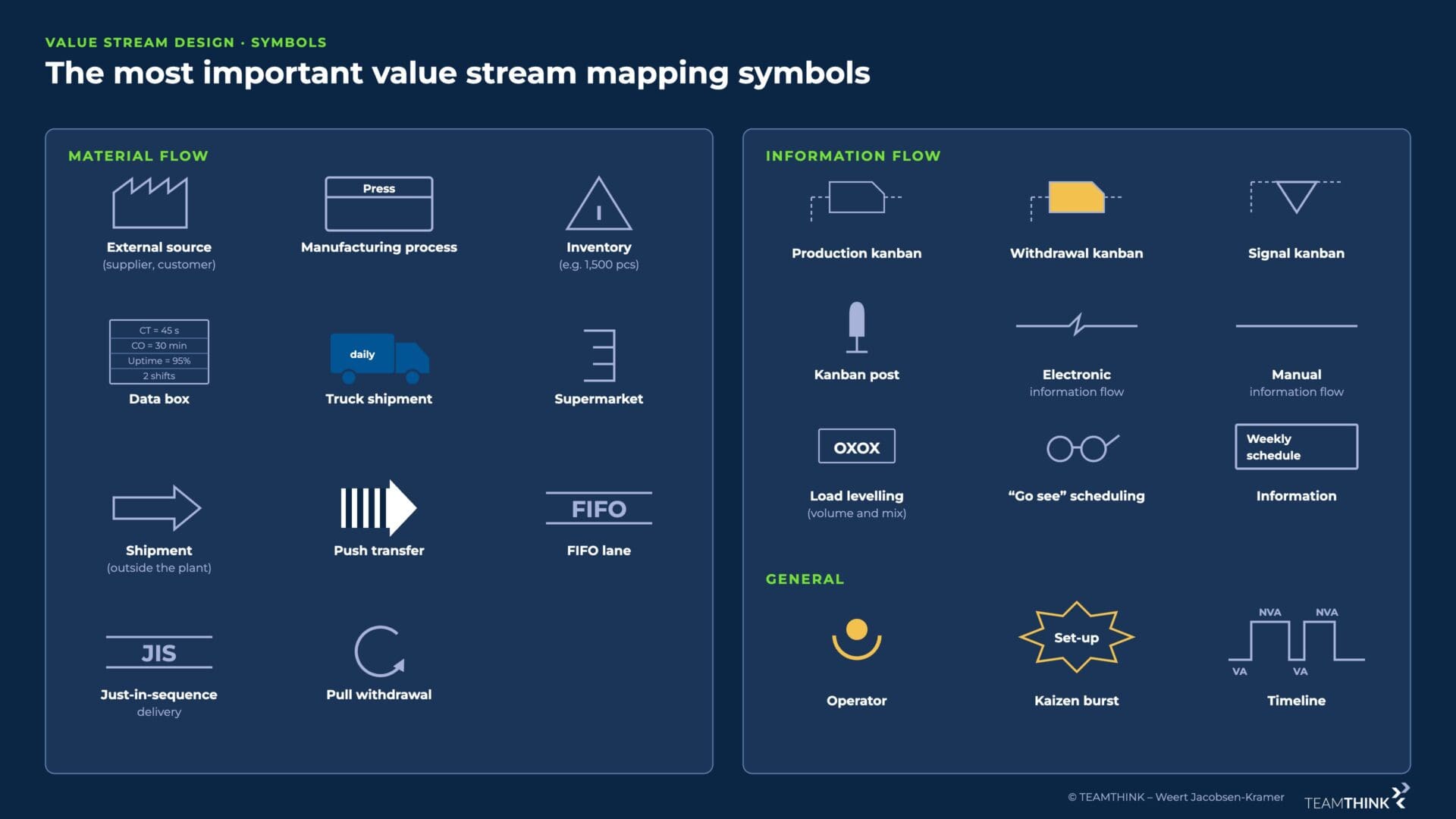
Now it begins and value stream mapping can start. Using standardised symbols, we map the process flow in the value stream with sticky notes .
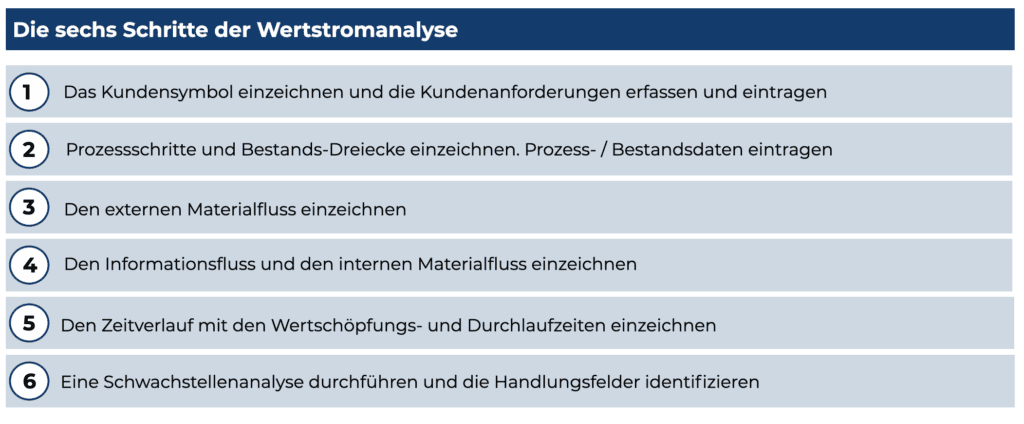
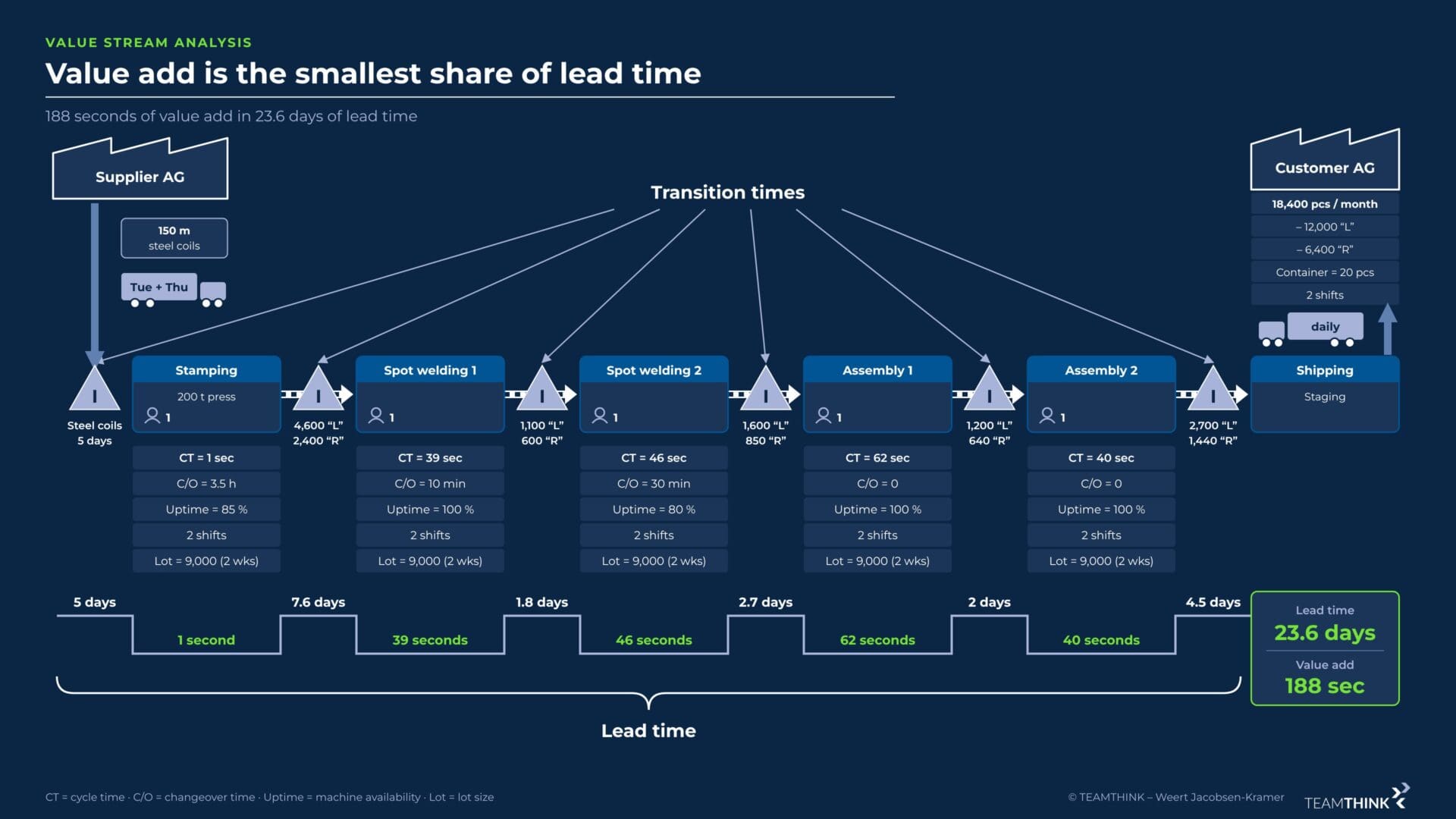
We record the customer requirements, calculate the customer takt and draw in the customer symbol. We draw in the process steps and inventory triangles and determine the cycle times and process times.
The team gets the necessary data from the ERP system or goes to the gemba and measures the times manually. Finally, employees and shift times are added and the team calculates the resources.
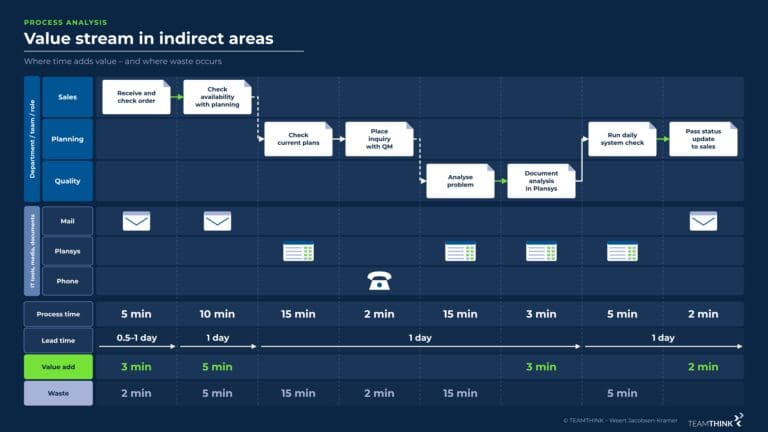
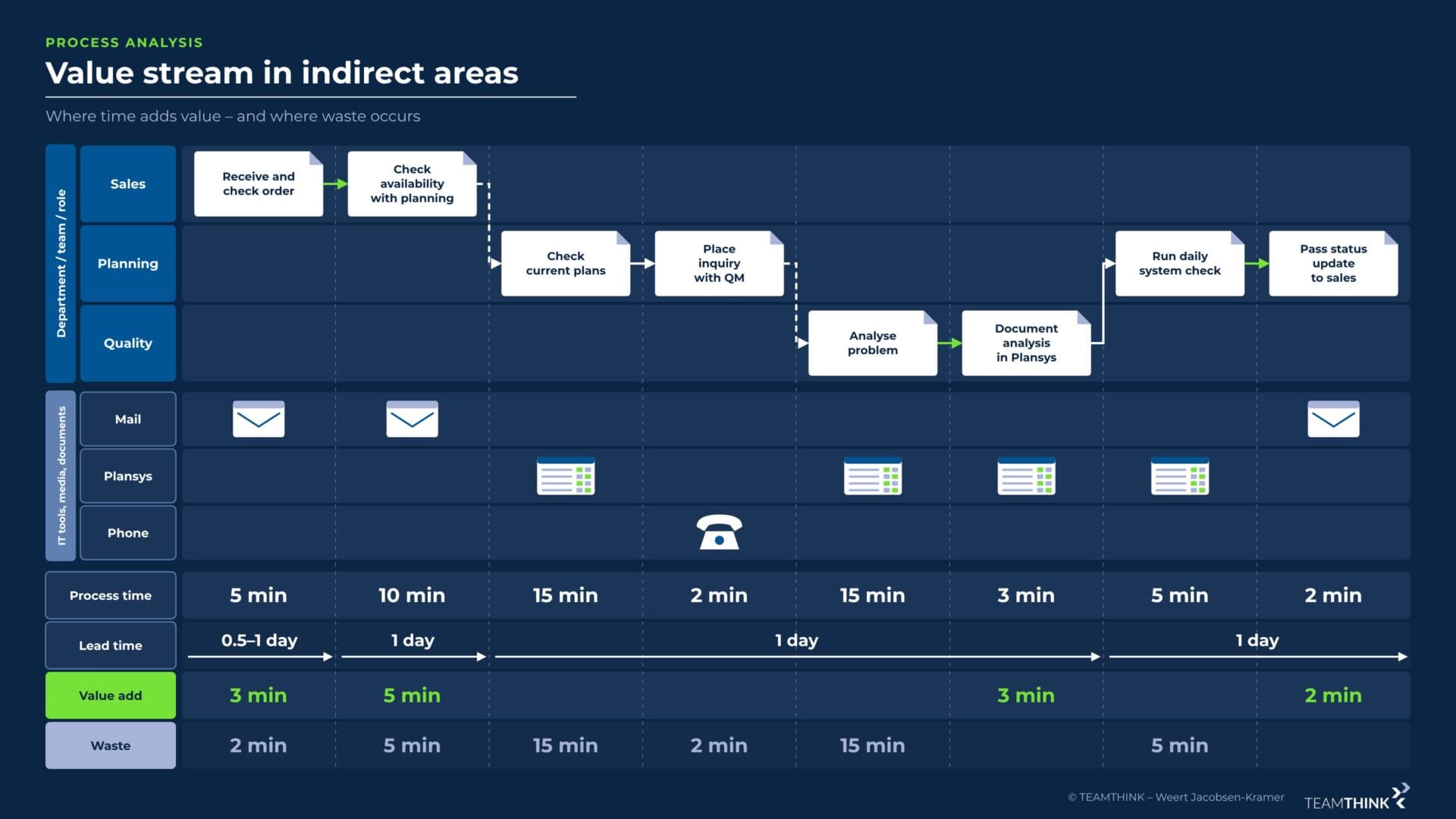
In indirect areas such as order processing, planning or quality, we map the value stream as a swimlane. How exactly this works is shown in the article on the Makigami method of process analysis.
Then it’s back to the gemba to count the inventory in the process for the material flow . This is how we determine the waiting time between the process steps.
Finally, the external and internal material flow and the information flow to production, starting from the customer order, are added. From the data collected, the team calculates the lead time and the flow ratio, which is derived from the value-adding time, the cycle time and the waiting times.
The process of mapping the value stream triggers an important process of team development. Participants learn the lean way of thinking in practice and see the huge savings potential in the process!
At the same time, the team repeatedly experiences moments of disillusionment as the reality in the company becomes visible.
Value stream mapping and design – day 3
After a morning round, we analyse the cost structure in the value stream. All data and relevant KPIs of the company are now available.
In the next step, the team defines the improvement points in the value stream. Kaizen blitzes mark where action is needed in the value stream.
The consultants explain various tools for detailed analyses such as set-up time analysis, spaghetti diagram, chalk circle, work sampling.
The team carries out these detailed analyses at specific points on the shop floor , to get an even better overview. The results are discussed together.
Value stream mapping is now complete and the hardest part of the week is behind us. We have a clear picture of the overall situation and full transparency. On the one hand, the team sees the huge potential for improvement. On the other hand, there is some disillusionment: we could be so much better!
All workshop participants now walk across the shop floor with completely new eyes. They have “learned to see”. Participants recognise waste in the process everywhere.
The third day ends with the realisation that there is still a lot of room for improvement. Participants look forward to the next day, when the new value stream design is to be developed.
Value stream mapping and design – day 4
After the morning round, the consultants give an input on the 5 lean principles in preparation for value stream design.
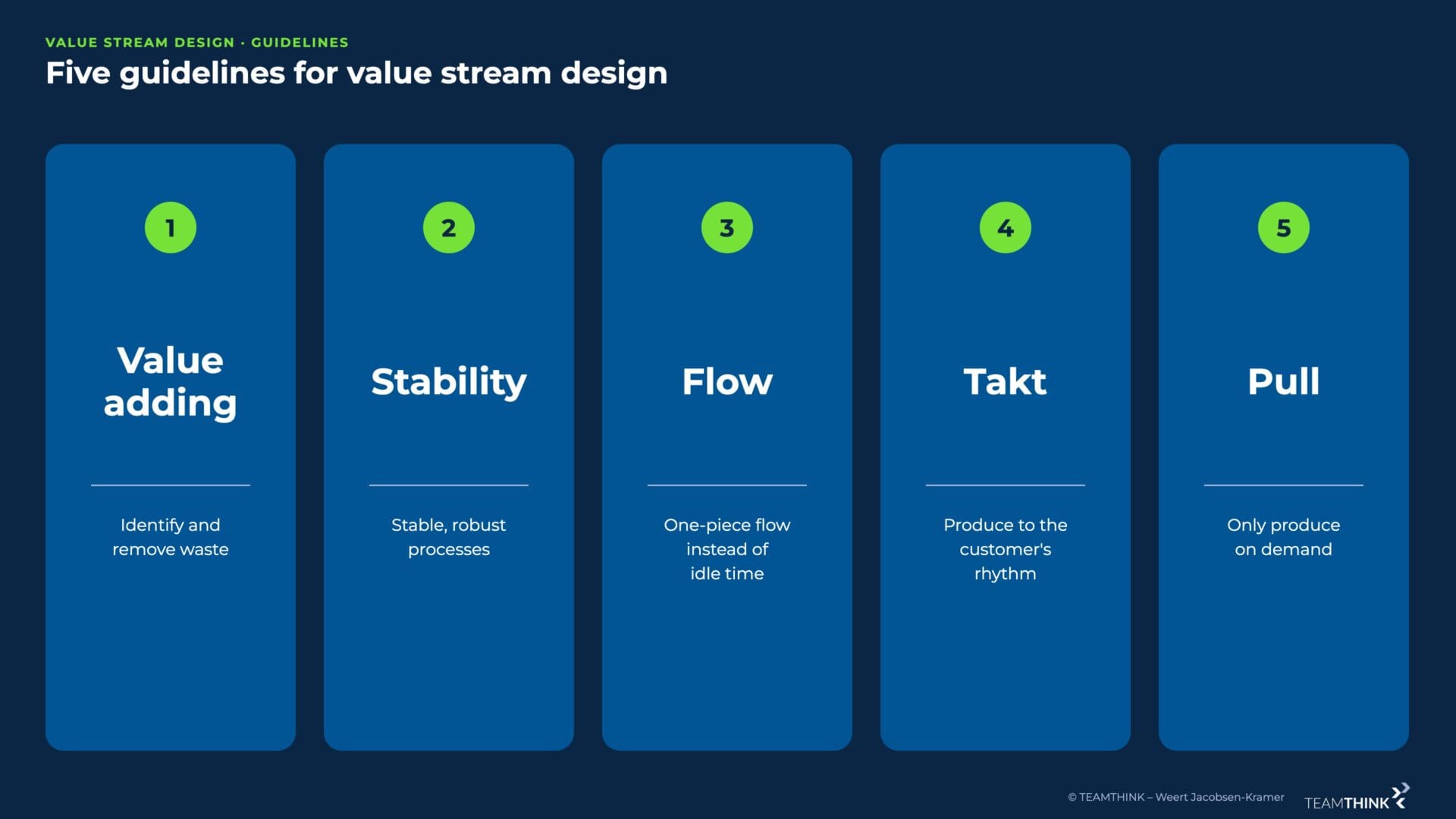
Since the principles of value creation and freedom from disruption were already discussed on the previous days, we focus intensively on flow and linking in the value stream (chaku-chaku principle) as well as levelling and smoothing production on the basis of the customer takt (heijunka). Finally, pull production using kanban systems is discussed.

After a break, it’s time to get to work. With the help of the consultants, the group applies what it has learned on the basis of the 7 guidelines for value stream design and designs the new value stream. The group is full of energy. It sees the potential and workable solutions!
After a few iterations, there are two scenarios for each new value stream design : a conservative new design and a radical design.
The breakthrough has been achieved. With this new value stream design we are able to reduce the lead time impressively!
The team is enthusiastic and discusses the opportunities arising from the new value stream. Implementation in reality is checked and planned.
To put the value stream design into practice and based on the current challenges in the value stream, the group now derives the relevant sub-projects as part of the lean transformation . After an intensive discussion, a list of 10 highly relevant lean projects emerges.
Finally, we use the group’s know-how to compile a collection of best-practice / benchmark solutions for selected topics and close the day.
Value stream mapping and design – day 5
After the morning round, the group looks at the results of the work sampling.
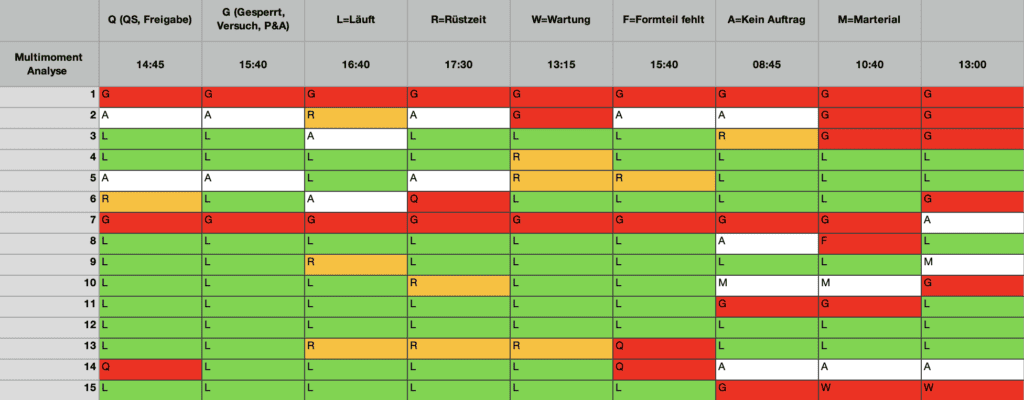
During the 5-day workshop, one of our consultants in the team was on the shop floor at different times and recorded, at around 10 measurement points, the productivity of the machines in the relevant value streams. The consultant recorded the running time, set-up time or downtime for other reasons at each point.
From these point values, the consultants estimate the overall equipment effectiveness (OEE) in relevant areas. Even if the values are not fully robust, the OEE determined in this way is a good indicator of equipment effectiveness. The group discusses the results and is surprised that the estimate matches reality quite well.
Once again, the pressure to act in the company becomes clear. All participants now understand: we have to change something!
In the next step, the team develops, in small groups, a project charter for each of the sub-projects defined the day before. Work packages, milestones, duration and target date, the project team and the project lead of the sub-projects are defined.
The team then makes a rough calculation of the cost savings that can be achieved per completed sub-project . It becomes clear that the projects can deliver a considerable reduction in costs.
At the end of the 5 long days, all sub-projects are summarised once more in a lean master plan and critically checked for realistic implementation.
The team is exhausted but satisfied. They see their company with new eyes and are excited about the intensive learning experience.
Implementation phase
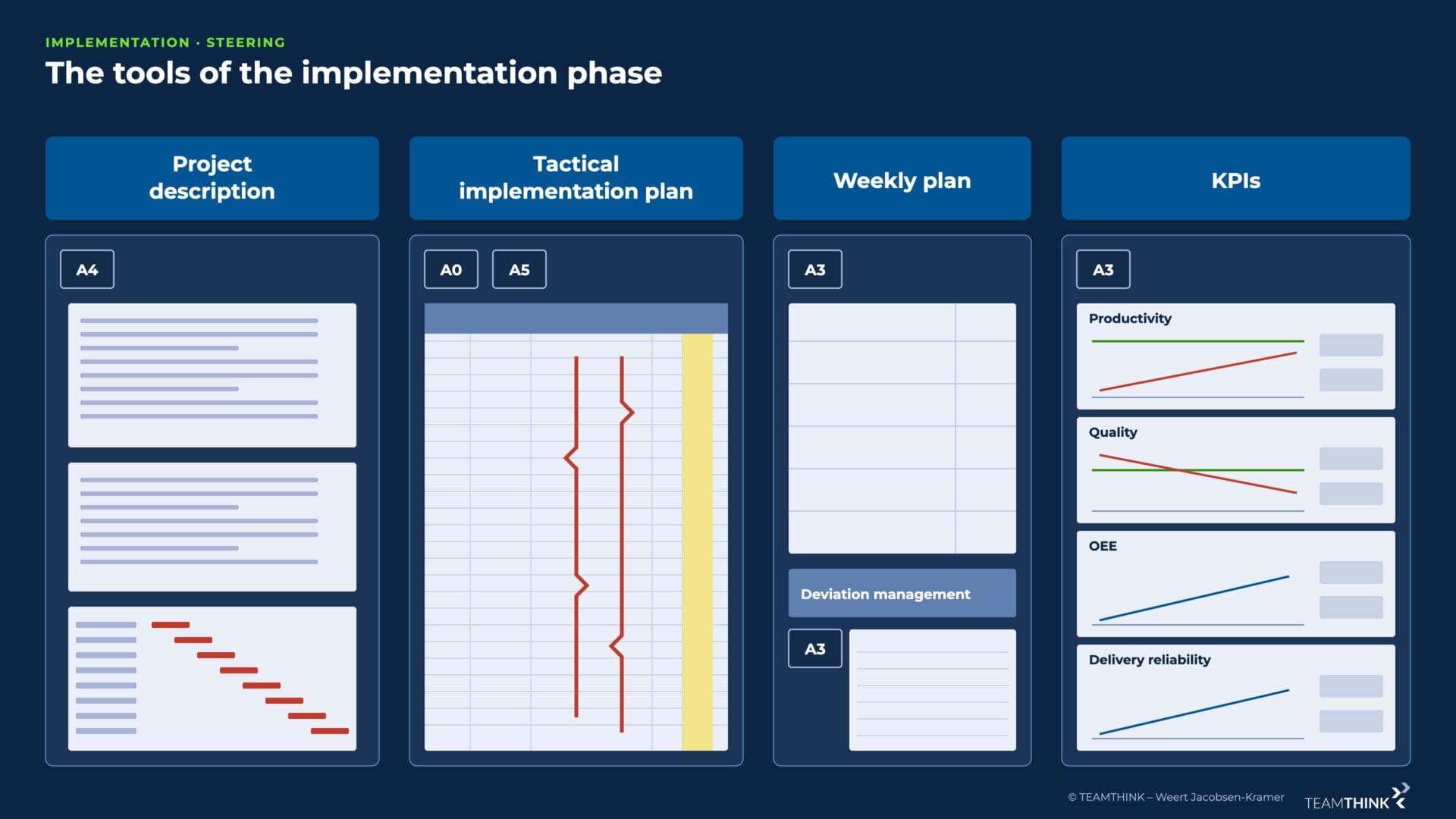
After the workshop comes the implementation phase. The next step is to develop and visualise a tactical implementation plan (TIP) and a weekly plan (WP) and KPIs to consistently check progress in the lean transformation.
At the place of visualisation, the regular communication for the lean transformation takes place with the change team / driver team of the lean transformation.
TEAMTHINK – specialist in lean transformation & leadership culture change
A lean transformation always goes hand in hand with a development of the leadership culture in the company.
TEAMTHINK specialises in lean transformation and leadership culture change.
On the one hand, we support our clients on their way to operational excellence on the basis of lean management.
On the other hand, we provide from a single source the necessary leadership training and culture change in the leadership team.
This gives our clients the entire transformation well coordinated from a single source.
TEAMTHINK · Operational Excellence
Where are the biggest levers in your value streams?
Since 2000, TEAMTHINK and its team of experienced consultants have been implementing lean management in production, development and indirect areas. In our on-site Quick Check, we spend two days looking at your processes and discuss the results with your management.