Monozukuri – hitozukuri – kotozukuri
The three terms monozukuri and hitozukuri and kotozukuri are essential for understanding the Toyota Production System.
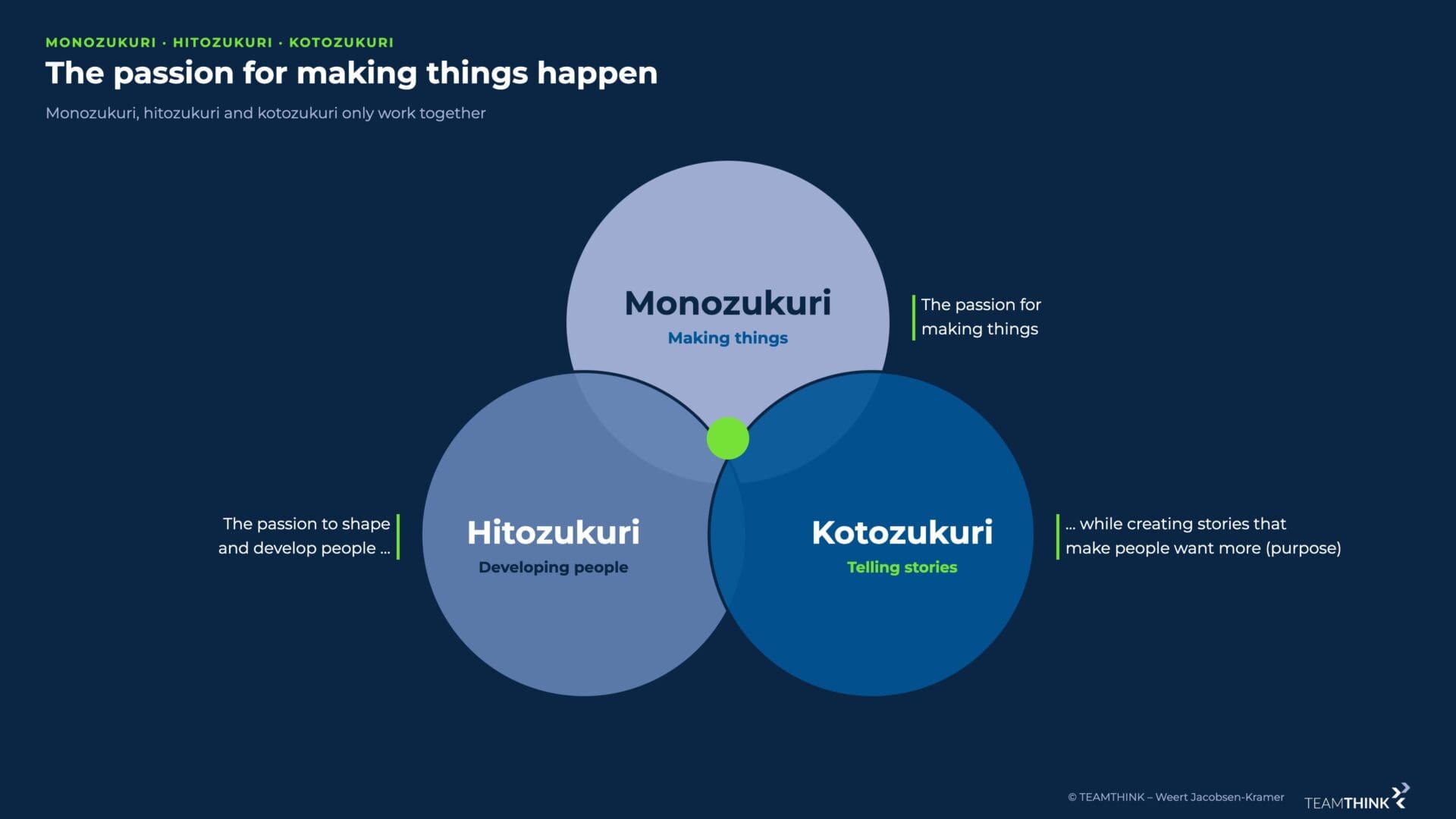
Put simply, monozukuri & hitozukuri mean “making things by shaping people”. The term kotozukuri translates as “making stories” and means making things happen. It refers to the passion for putting things into action, the value created by generating knowledge.
In the Toyota Production System there is a strong emphasis on the passion for making products, the development of employees and on strong narrativesthat trigger motivation, through which things get done.
This article explains the terms monozukuri, hitozukuri and kotozukuri and their meaning for the Toyota Production System.
Monozukuri
The Japanese word monozukuri is a combination of “mono” (thing) and “zukuri” (making). Literally, monozukuri means roughly “making things” and is the Japanese term for “manufacturing“.
The literal translation, however, does not capture the full meaning. Monozukuri includes a passion for making productscombined with a striving for perfection through continuous improvement , which leads both to a gain in quality and to greater skill in the sense of craftsmanship .
“Monozukuri” stands for the spirit of Japanese manufacturing practices. This spirit includes a sincere attitude towards production with pride, skill and dedication, as well as the pursuit of innovation and perfection.
“The term monozukuri has only been in use for a relatively short time. In 1998 the office of the Japanese prime minister set up a “monozukuri kondankai” (advisory council for monozukuri) and passed the Basic Act on the Promotion of Core Manufacturing Technology. Its aim was to reverse the trend towards deindustrialisation and the hollowing-out of Japan after the end of the Japanese financial bubble in the 1990s by reaffirming Japan’s strengths in manufacturing.” (Source: Japan International Consulting)

Hitozukuri
The term monozukuri goes hand in hand with the term “hitozukuri” , which refers to the passion for developing people .
Hitozukuri translates as “making people” and stands for the passion and art of developing people through an educational process, with the emphasis on lifelong learning .
This is about developing people’s skills in their field , but also their ability to work with others across functional boundaries.

Kotozukuri
The term kotozukuri translates as “making stories” and means making things happen. It refers to the passion for putting things into action, the value created by generating knowledge.
It is about the energy, the vitality to keep both monozukuri and hitozukuri strong by encouraging doing, not just thinking. The main driver of kotozukuri is storytelling – the need for a strong narrativethat triggers motivation and energy in employees and gets them to act.
Monozukuri & hitozukuri & kotozukuri
These three terms complement each other and are used and applied togetherin the Toyota Production System, in which the methods and tools of lean management are introduced.
Toyota holds the following view: “Monozukuri wa hitozukuri kara”, which could be translated as:
“Making things starts with making people.”
This sentence describes the close interweaving between the development of people and the improvement of techniques through the pursuit of performance.
If we compare people, machines and material with each other, we see that machines and material can only be changed to a limited extent .
People, on the other hand, have dreams, imagination and passion, and they can learn. People are able, through innovation, to make good use of material and machines to good effect.
At the same time, people need “kotozukuri”for change, that is, strong narrativesthat drive them so that things are actually implemented and happen.
In the Toyota Production System there is a strong emphasis on the passion for making products, the development of employees and on strong narratives that trigger motivation and make things happen.
Monozukuri, hitozukuri, kotozukuri
Below, interested readers will find an article by Michael Ballé, Daryl Powell and Kodo Yokozawa, published on Planet Lean, which explains the terms monozukuri, hitozukuri and kotozukuri in detail. Source: Planet Lean
BY MICHAEL BALLÉ, DARYL POWELL AND KODO YOKOZAWA
The slogan “Good thinking, good products” can be seen everywhere at Toyota – from a banner hanging from the ceiling of a plant, to the first exhibit in the Toyota Commemorative Museum, to the farewell gifts handed out after a plant tour.
Toyota’s lean strategy is clearly product-based and rests on the idea of “one-time customer, lifetime customer”. Once you have bought a Toyota, you should find your next car in the Toyota range and never want to drive another brand again.
This strategy relies on four essential features. First, a broad and frequently updated product range (the result of aggressive product planning). Second, engineering knowledge and skillto develop cars that combine the robustness of earlier models with bold developments that capture the spirit of the times. Third, skilled manufacturingthat reliably and safely produces high-quality products at ever lower cost in order to stay competitive. And finally, strong partnerships with suppliers to benefit from a constant flow of materials (e.g. regular deliveries of parts in daily production) and from innovation (such as the design and development of components, modules, platforms and vehicles).
As long-time students of lean and Toyota, we were familiar with the core concept of monozukuri through hitozukuri:
- Monozukuri stands for “making things” – the passion or art of making things, which in the Toyota context means keeping the spirit of craftsmanship alive in industrial production by always striving for better quality and lower cost through kaizen.
- Hitozukuri stands for “making people” – the passion and art of developing people through an educational process, with the emphasis on lifelong learning. This is about developing people’s skills in their field, but also their ability to work with others across functional boundaries.
Beyond Toyota, lean theory is clear. It goes back to the Japanese response to Dr Deming’s challenge to build quality into the processby checking work during the process rather than only at final inspection.
In every industrial company, both monozukuri and hitozukuri are a constant challenge. As the tasks of craftspeople are gradually taken over by machines (whether on the assembly line, in accounting or, more recently, through websites and apps in the sales shop), operations become black boxes that nobody fully understands any more.
Over time, people lose clarity about how things work and what their deeper purpose is. Machines are absolutely necessary, but they do not lead to new, innovative processes and they do not learn to deal with unexpected conditions.
Monozukuri is the art of using machines, whether as large as a stamping press or as complex as an AI system, as a craftsman’s tool to produce outstanding human work: people are always the driver. To maintain a high level of care in repetitive, highly automated processes, Toyota developed a four-part theory designed to help bring problems to the surface:
- Standards: making a result repeatable by dealing with the unpredictable problems at each step and learning how to make the unpredictable predictable – only people can do this.
- Jidoka: bringing problem situations and deviations from the norm to the surface as quickly as possible, so that the conditions of the problem can be examined while they still exist (conditions evaporate quickly). This is achieved both by machines that diagnose themselves and signal when they deviate from the norm, and by employees who check their own work and call for help when they have doubts about its quality. As problems are solved and the work is better understood, solutions can be built into the normal workflow and the system as a whole makes progress.
- Just-in-time: by using kanban cards to clarify which work needs to be done now, in the required quantity and at the required time, the kanban system relieves front-line managers of scheduling and lets them focus on delivering only good work on time by solving problems with people, machines, materials and methods as soon as they arise.
- Basic stability of demand (no overburden from peaks or downtime from troughs), of tools (tools that work) and of teams (you know the people you work with well).
Monozukuri relies on human insight and ingenuity through kaizen: the conviction that no process is ever perfect, and the spirit of always looking for a better way by trying things out one at a time. In Toyota’s theory of innovation, kaizen is the incubator of innovation, because kaizen activities create an environment in which change is sought and accepted every day.
Kaizen is the main arena of hitozukuri, the development of people. Children learn by discovering new concepts and vocabulary. Teenagers learn by discovering facts and procedures. Adults, on the other hand, already know most of this and are full of personal experience. For adults, learning is essentially problem-based: by solving specific problems, adults confront what they know from experience (their “remembering self”) with what they are experiencing right now (their “experiencing self”), and this confrontation leads to new discoveries, new ideas and new memories … in other words: new learning.
Toyota’s theory of developing people at the workplace is based on:
- Knowledge of the work: understanding the content of the work, the theory behind each work step and the problems that can arise in different contexts.
- Motivation: confidence in one’s own achievements and willingness to take on a challenge.
- Room to think: a concrete challenge with room to think and support to try things out until a new, better method is found.
- Improving oneself: the ability to do the work under more demanding conditions – working better with others, having one’s initiatives accepted by colleagues, and taking on more or different responsibilities.
The principles of monozukuri – achieving customer satisfaction through just-in-time, jidoka and standards – create the conditions for kaizen and hitozukuri, which in turn lead to better monozukuri by learning to make machines, processes and departments work together better to deliver more value to customers: higher quality at lower cost.
But, as Deming himself noted long ago, “eliminating defects alone does not guarantee jobs in the future”. Products compete on three essential fronts: performance, quality and price. Quality is essential, but no more important than performance. The best mobile phone in the world is of little use to you if it is not also an app platform.
Product B is more expensive than product A but has a performance advantage – customers may be willing to accept the cost-benefit trade-off. As Deming argues, performance and style (we can include style in the broader sense of performance) must also show continuous improvement.
And that is exactly the case at Toyota. The chief engineers of Toyota cars constantly argue with the heads of the design departments and the manufacturing directors about bolder style and performance decisions, while the functional heads counter that keeping to known standards is the only way to ensure quality. This is a constant debate, and as one chief engineer told us, the secret of a great car is “a lot of conflict”.
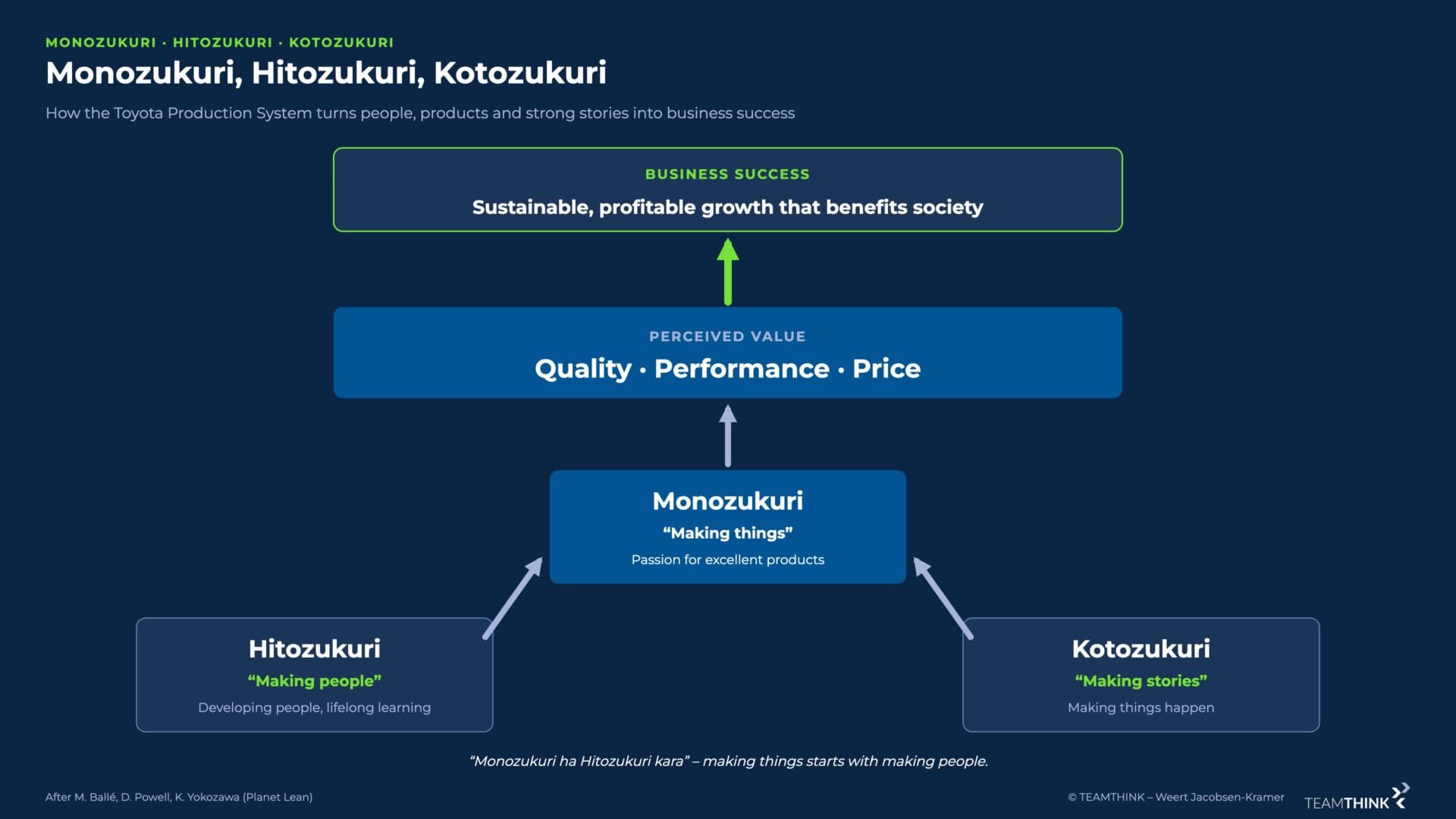
We found that, alongside monozukuri and hitozukuri, there is a third important “zukuri” term: kotozukuri, making things happen. It refers to the passion for putting things into action, the value created by generating knowledge. The energy, the vitality to keep both monozukuri and hitozukuri strong by encouraging doing, not just thinking.
Any process that turns perceived human needs into design specifications and manufacturing instructions inevitably becomes bureaucratic and falls prey to big-company disease: process before customer preference, silos before value flow, compliance before talent, legacy before innovation.
The same focus on eliminating variation in order to make every task reliable and repeatable also kills the human spirit of inquiry and creativity, leading to habituation, thoughtless decisions and poor results. In every organised process we will always have three difficult problems:
How do we keep engineers open to customers’ evolving tastes so that they design exciting, functional products?
How do we bring this engineering passion into manufacturing to make cool, robust products or services at affordable cost?
How do we bring suppliers and partners on board to benefit from the latest technologies and achieve the two goals above?
This energy is by no means found only at Toyota. Steve Jobs, for example, had plenty of it. When his engineers brought him the first version of the iPhone, he found that carrying it in his pocket together with his keys scratched the plastic screen. A month before the iPhone’s launch he told his engineers: “I won’t sell a product that gets scratched. I want a glass screen, and I want it perfect in six weeks.” This energy, which he applied to many issues, gave us a product that changed the company, our lives and, to some extent, the world.
Toyota, however, is the only company that has tried to capture and theorise kotozukuri in order to teach it.
Kotozukuri brings together two basic notions: the need for a strong narrative (e.g. the product concept) to rally everyone behind a common direction of improvement, and the management energy to turn the narrative into reality through concrete improvements.
Kotozukuri is about mastering three challenges :
- Finding the story, that resonates with customers: How do we capture the spirit of the times while holding on to what our customers expect from our products and services?
- Discovering and developing people who make the story come true: Which of our employees have the talent to see the customer story beyond their own narrow specialism, and which new skills do we need to acquire to keep up with the times?
- Management energy to make the story real from design to production and delivery: How do we create the collective leadership that makes functional heads work together for the customer?
Kotozukuri takes place:
- at the gemba, through leaders’ gemba walks to explore emerging problems and to see what efforts teams are making to reach the goals;
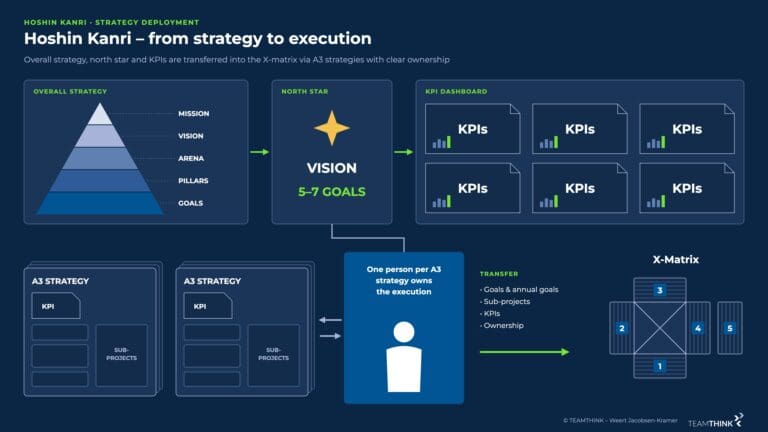
- in the boardroom through hoshin kanri and the clear statement of what each leader intends to do to support the company’s overall strategy;
- and in middle management meetings with A3 problem solving and work at the interfaces between technologies and systems.
The management team of Kongsberg Maritime Subsea in Horten, Norway, for example, aims to “make things happen” through regular gemba walks. Through a process of discovery at the gemba, managers are better able to recognise problems and opportunities for improvement by observing problems in their natural environment. Things do not just happen in the meeting room; instead, management wants to “see with its feet and think with its hands”.
Kongsberg Maritime Subsea has been on a lean journey since 2014, when the company launched its lean programme, The KONGSBERG Way. Initially, the company focused on lean thinking and practices in its supply chain organisation and achieved some promising results – including winning the Norwegian Lean Company of the Year award in 2017. Bjørn Jalving, Executive Vice President Subsea, now sees creating a truly lean enterprise as the company’s next challenge. To achieve this, the company has introduced the slogan Better Thinking, Better Products. “This slogan is about creating space for our people to think and motivating team members to make suggestions for improving our products and processes,” says Bjørn. “The vision is simple: sustainable, lean growth. And we will realise it by eliminating waste and focusing even more strongly on creating customer value, to make our products and processes safer, better, faster and cheaper.”
Dr Deming’s main message wasthat quality is made by top management . In more modern terms, it is what Amazon’s founder and CEO Jeff Bezos calls “high standards” , applied at every level down to the smallest detail. Deming’s recipe in the 1990s was to improve style and performance while reducing defects:
Bezos advised maintaining high standards in invention, customer care and hiring at Amazon from the very beginning; but he also learned that operational processes require high standards, such as fixing problems that have been fixed, eliminating the root cause of defects and checking processes within the process itself. Twenty years later (or more), both recipes are strikingly similar and as relevant today as in the 1950s, when Toyota developed its method for this.
Monozukuri through hitozukuri is not enough, to make your company successful without the effect of kotozukuri – shaping the stories that carry the energy to bring the engineers’ passion for customer satisfaction all the way into production and delivery.
The management effort lies in finding the right stories, bringing people on board and supporting them in developing the knowledge and tools to make these stories come true every day.
To see the true strategic impact of lean thinking, we need to add a third leg to the stool, one that supports customer satisfaction beyond monozukuri and hitozukuri: we need to learn more about kotozukuri.
TEAMTHINK – specialist in lean culture change
A lean transformation always goes hand in hand with a development of the leadership culture in the company.
TEAMTHINK specialises in lean transformation and leadership culture change.
On the one hand, we support our clients on their way to operational excellence on the basis of lean management.
On the other hand, we provide from a single source the necessary leadership training and culture change in the leadership team.
This gives our clients the entire transformation well coordinated from a single source.
TEAMTHINK · Operational Excellence
Where are the biggest levers in your value streams?
Since 2000, TEAMTHINK and its team of experienced consultants have been implementing lean management in production, development and indirect areas. In our on-site Quick Check, we spend two days looking at your processes and discuss the results with your management.