Lean house & 5 lean principles
What is the lean house? What are the 5 essential principles of lean management?
This article answers these questions.
The lean house
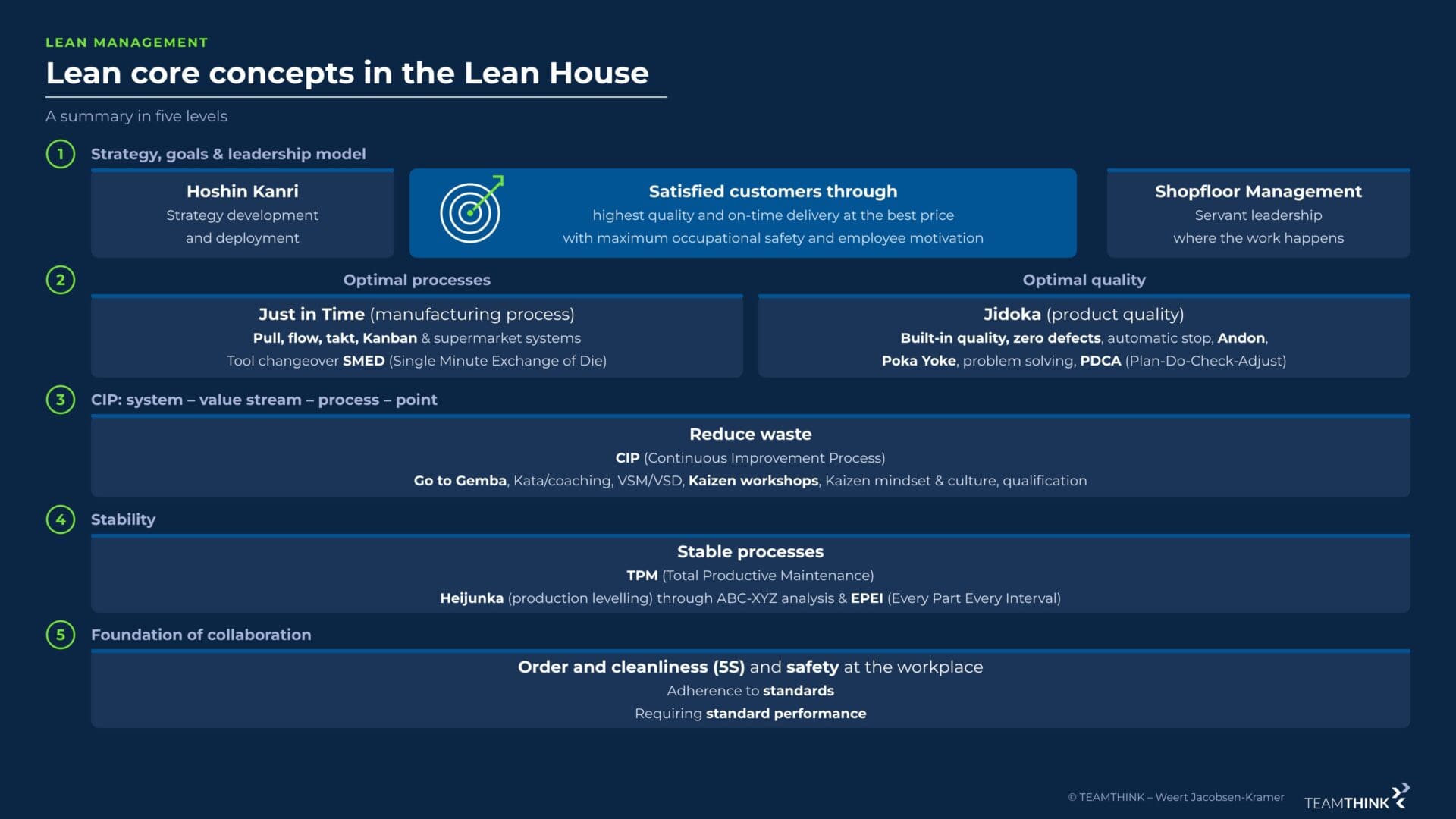
The lean house contains the essential concepts of the Toyota Production System developed by Taiichi Ohno (TPS).
The starting point – the roof of the lean house – in the Toyota Production System (TPS) is the customer. Customer focus means making a product with the best quality, at the lowest cost (best price) and with the shortest lead time (on-time delivery).
At the same time, occupational safety and high employee motivation are ensured, while waste in the manufacturing process is steadily reduced and the lead time is reduced further.
On the next level, a strong vision and mission of the company, within the framework of Hoshin Kanri strategy development and deployment , ensures that employees work together in a focused way on the basis of strategic pillars aligned with their business areas .
The lean house is essentially based on the two pillars of the Toyota Production System.
The concept of just-in-time covers the principles of takt, one-piece flow, pull/kanban and the concept of quick tool changes (SMED).
The concept of jidoka (“autonomation” or “intelligent automation with a human touch”) covers the principles of the zero-defect strategy, built-in quality, intelligent automation with an immediate production stop, as well as poka-yoke and the PDCA cycle for structured problem solving.
The base of the lean house – the foundation – consists of basic standards such as occupational safety, order and cleanliness, standard work and visual management. These principles create order, discipline and process orientation on the shop floor.
On this basis, stability can be achieved through Total Productive Maintenance (TPM) and smoothed and levelled production (heijunka) .
The status quo is continuously optimised through leadership (human management). Excellent leadership ensures a steady reduction of waste and process improvement, coaching in the process, process analyses and continuous shop floor management.
5 lean principles
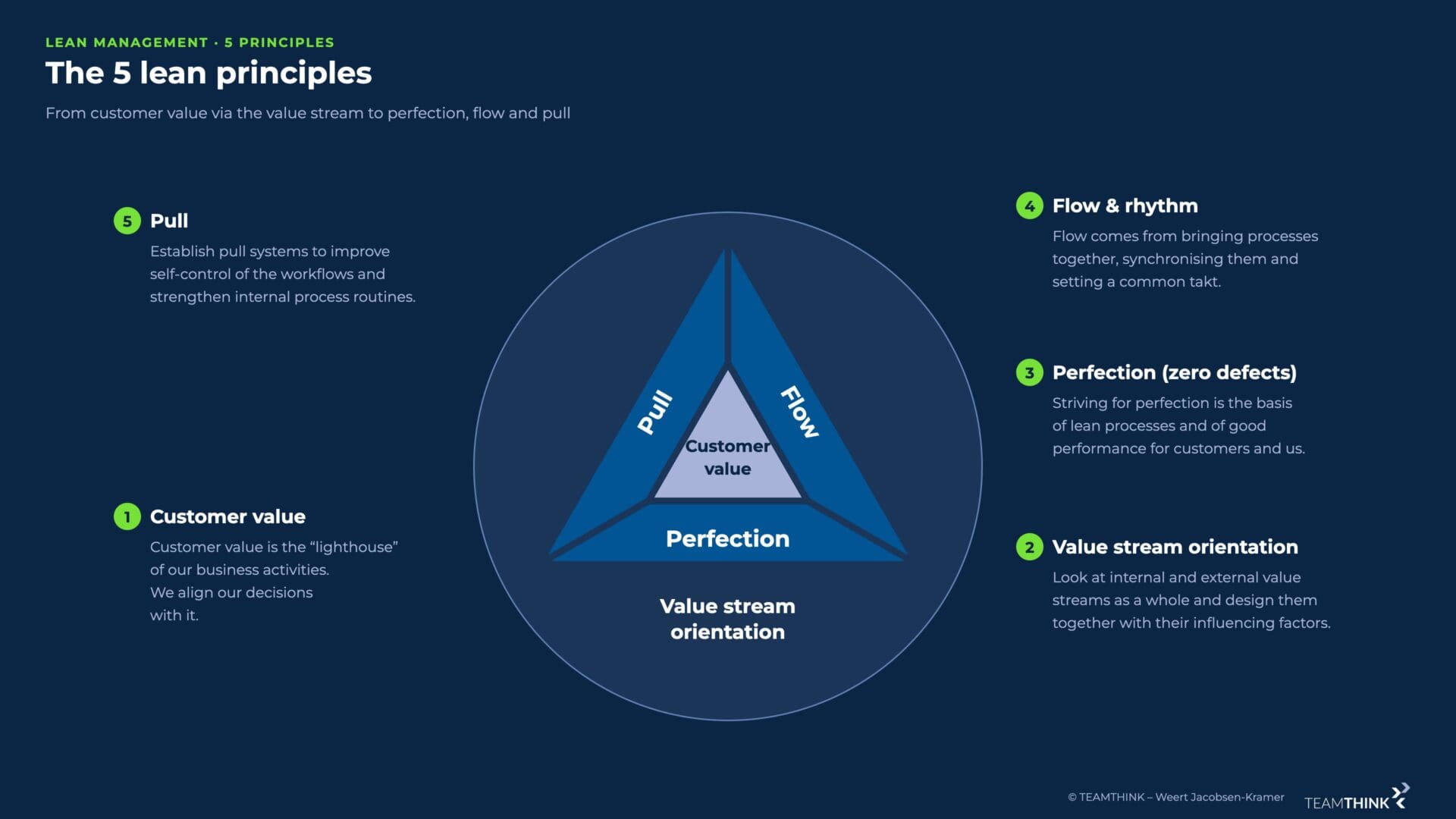
Sooner or later, anyone working with lean management comes across the lean principles. They describe how a process should ideally be designed to deliver optimal results. The lean principles are:
Value creation
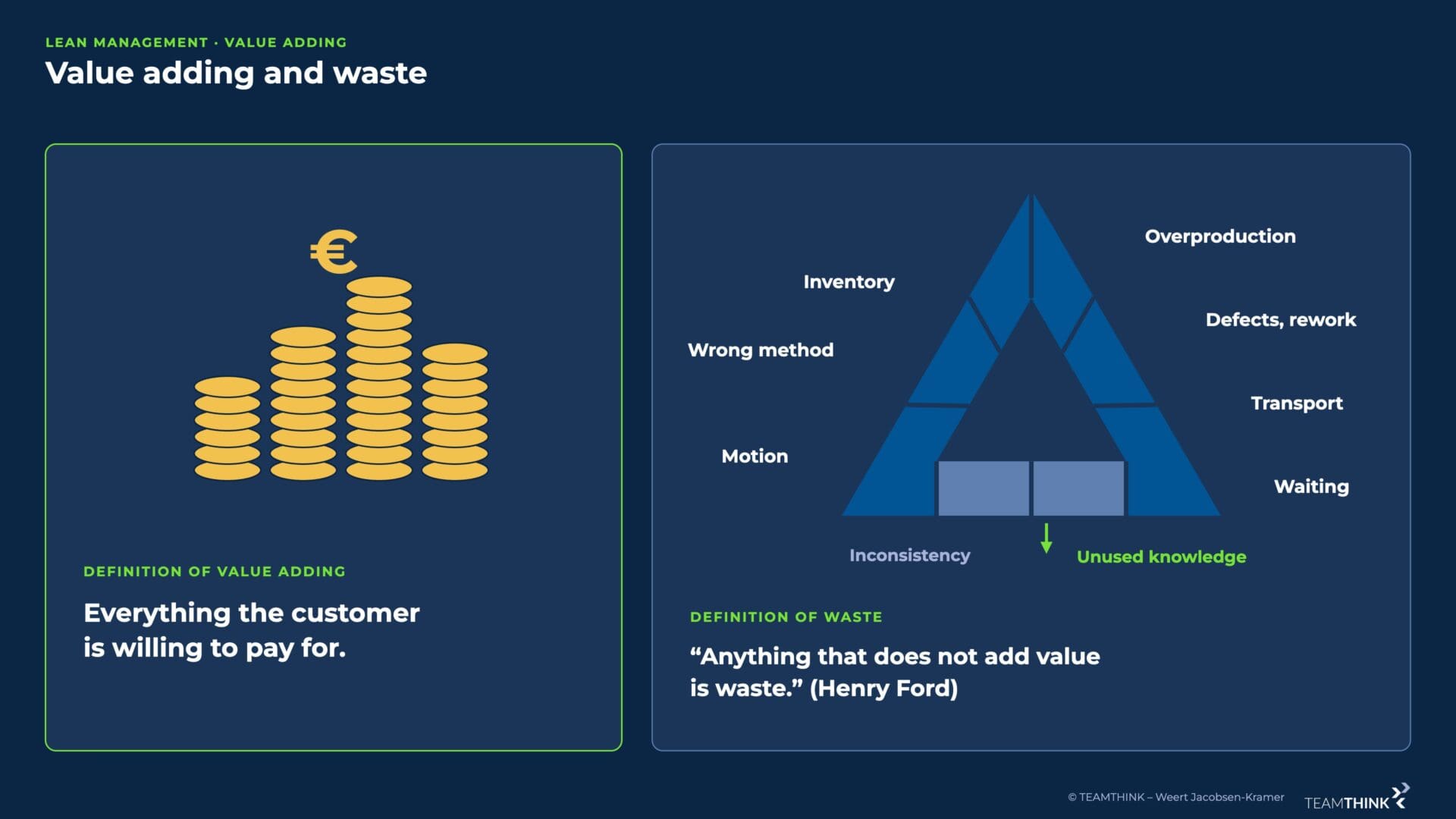
In the words of Henry Ford: “Value is everything the customer is willing to pay for”. This means we can only ever define value and value creation from the customer’s perspective.
All activities that create no value (for the customer) are therefore waste. Since waste does not contribute to value creation, it must be eliminated or, where that is not possible, reduced.
Muda, Muri, mura
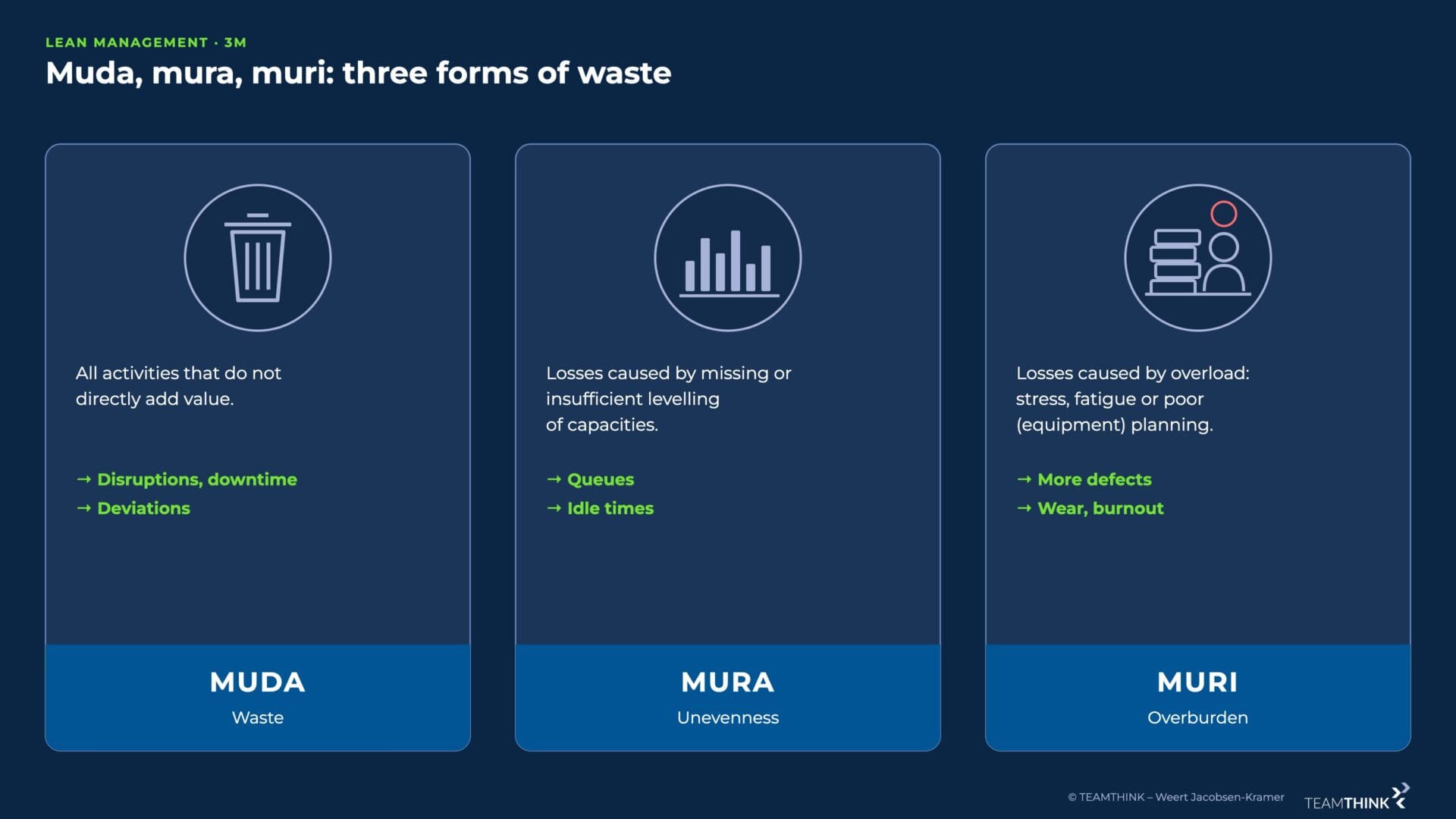
The Japanese terms muda (waste) and muri (overburden) and mura (unevenness) are also based on this way of thinking..
The term muda (waste) is widely known and rightly stands for the 7+2 types of waste. These are:
- Overproduction
- Inventory
- Defective parts, scrap
- Wrong work processes
- Transport
- Motion
- Waiting
We add two more forms of waste that relate directly to leadership:
- Failure to meet normal performance (normal performance is the expected, normal work output without overburden)
- Not using employee knowledge and potential
The term muri stands for overburdening or overstraining people, machines or materials. Examples are constant extra effort and overtime or, for example, output at the expense of health.
The term mura stands for unevenness or too much variance in processes. Examples are situations in which no standards are followed, there is no visualisation and customer requirements keep changing.
Freedom from disruption
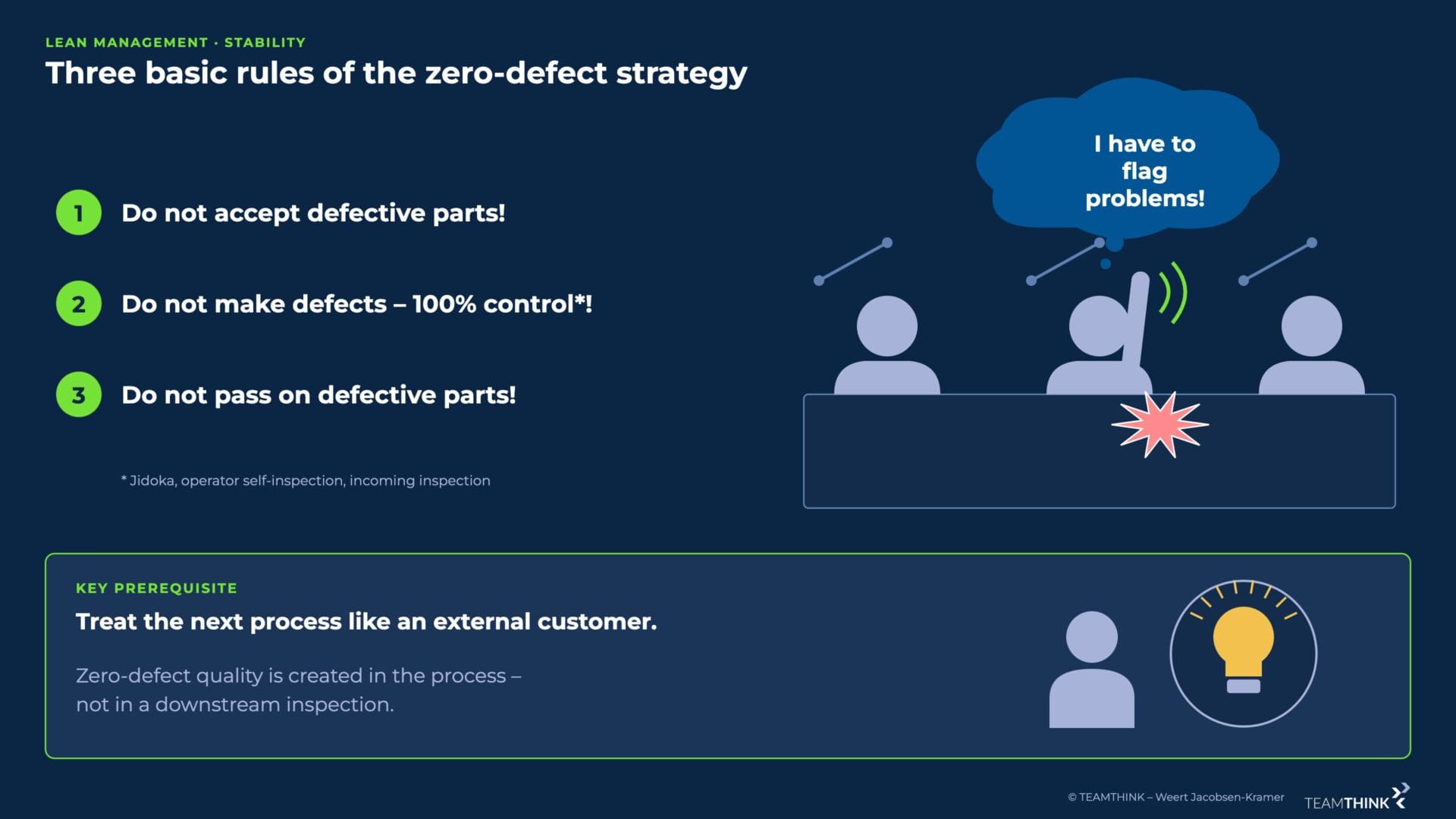
Robust, disruption-free processes are the basis for stability in value creation. Freedom from disruption can be achieved by establishing the zero-defect strategy, which builds quality into the process. Instead of assuring quality after production, quality is built into the process through input/parameter control and self-inspection by employees. At the same time, error-proofing solutions (poka-yoke) prevent errors from occurring at all. If errors do occur, production is stopped immediately to investigate the problem and eliminate the error straight away. For this we use the PDCA cycle for structured problem solving.
To achieve freedom from disruption, occupational safety, order & cleanliness and visualisation must first be established on the shop floor. They form the basis for robust, disruption-free processes.
Flow
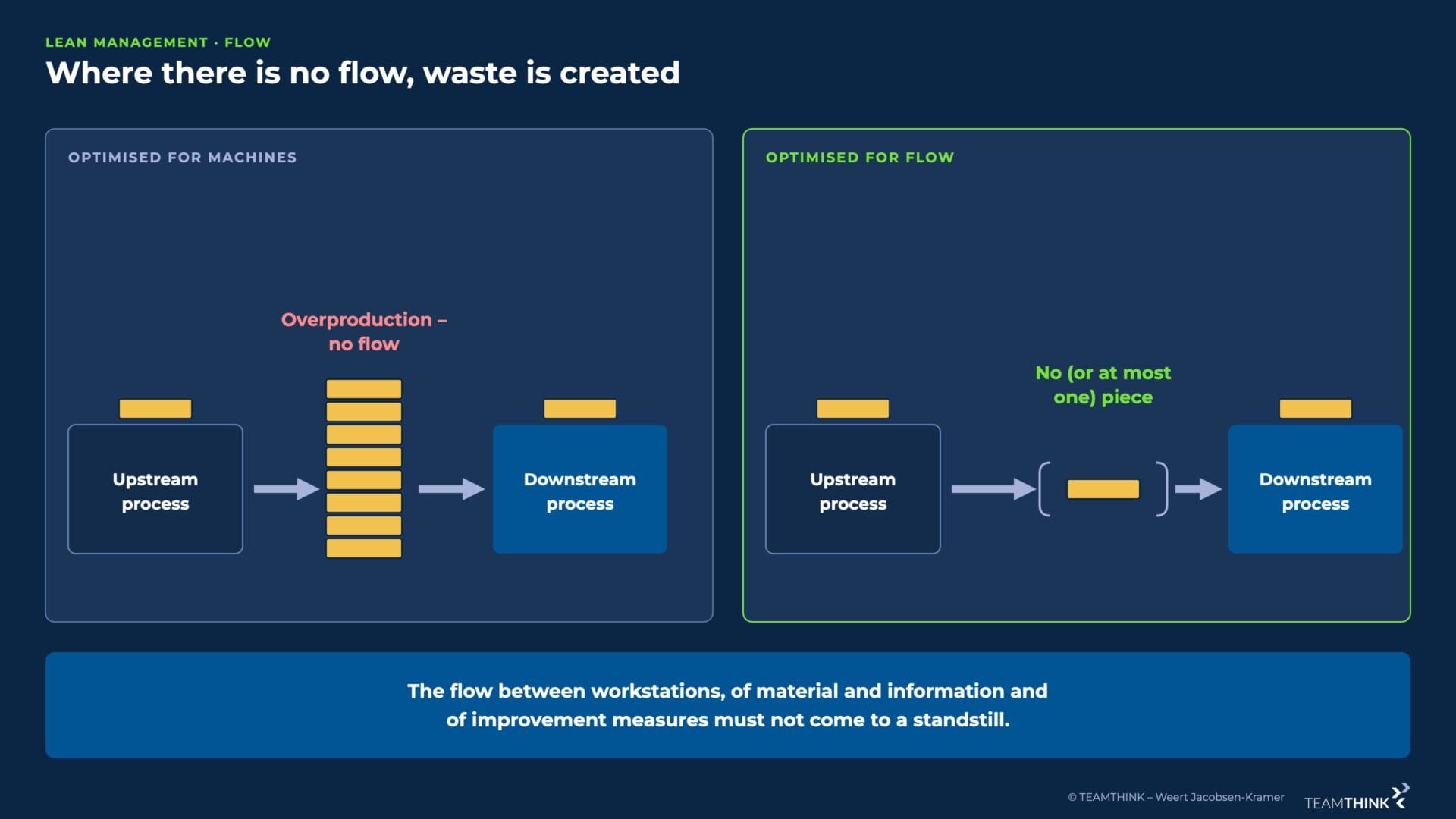
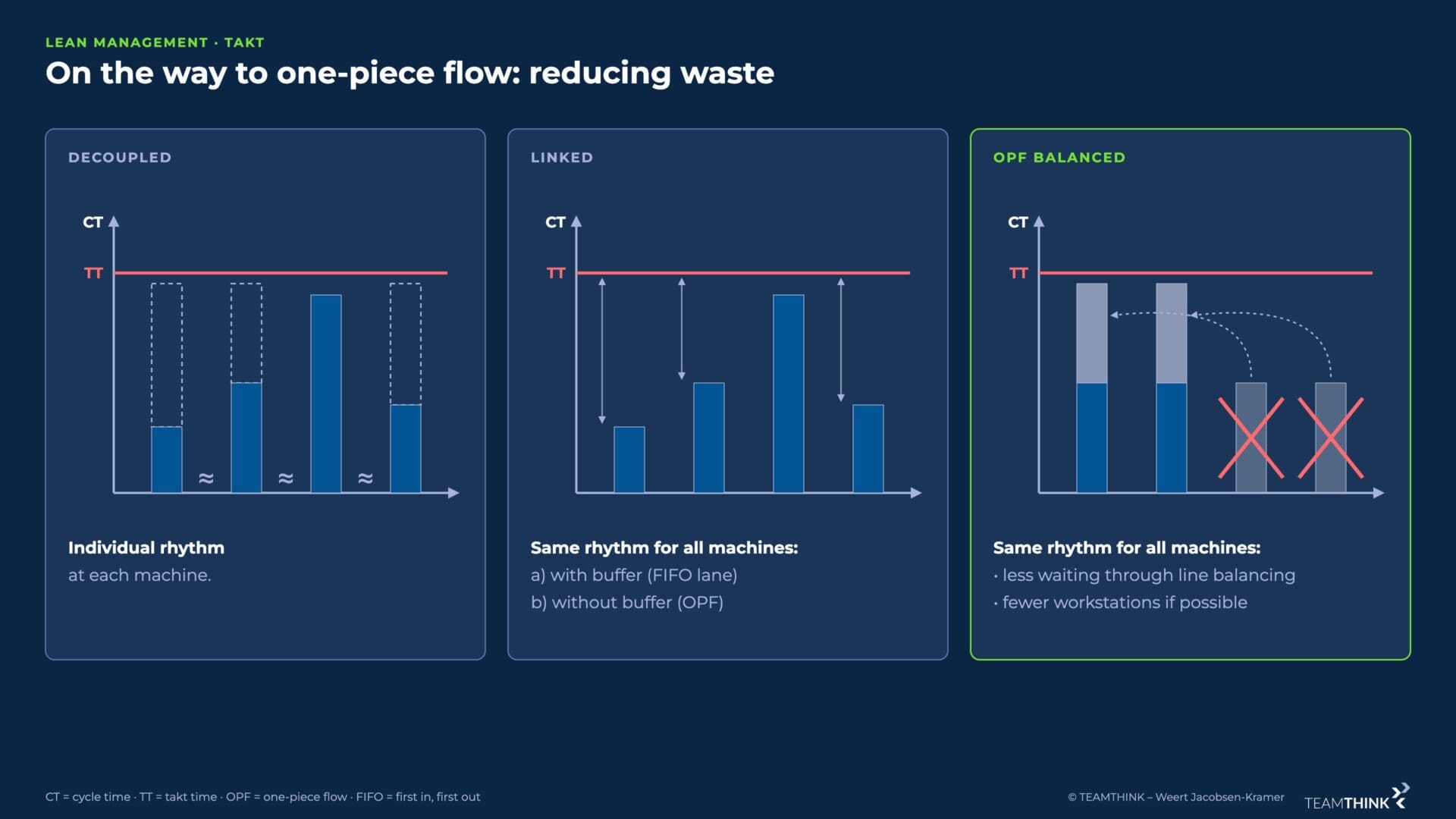
In the ideal case there is a continuous one-piece flow from raw material to finished product. Where production does not flow, waste in the form of inventory builds up between the process steps. The goal is therefore a continuous flow with the smallest possible transfer quantity. This strategy minimises lead time.
Flow is achieved by synchronising and linking process steps in the value stream. In production we see U-cells, arranged according to the chaku-chaku principle , with the operator carrying the parts from step to step.
Takt
The customer takt defines the required production rhythm. The customer takt states how much time a given activity should ideally take in order to meet customer demand exactly at the right moment – just-in-time.
On this basis the process can be balanced, i.e. levelled and smoothed on the basis of the customer takt. The aim is to create a uniform, levelled production flow by putting orders into a fixed, repeating sequence and smoothing daily fluctuations so that unevenness is avoided (heijunka).
Pull
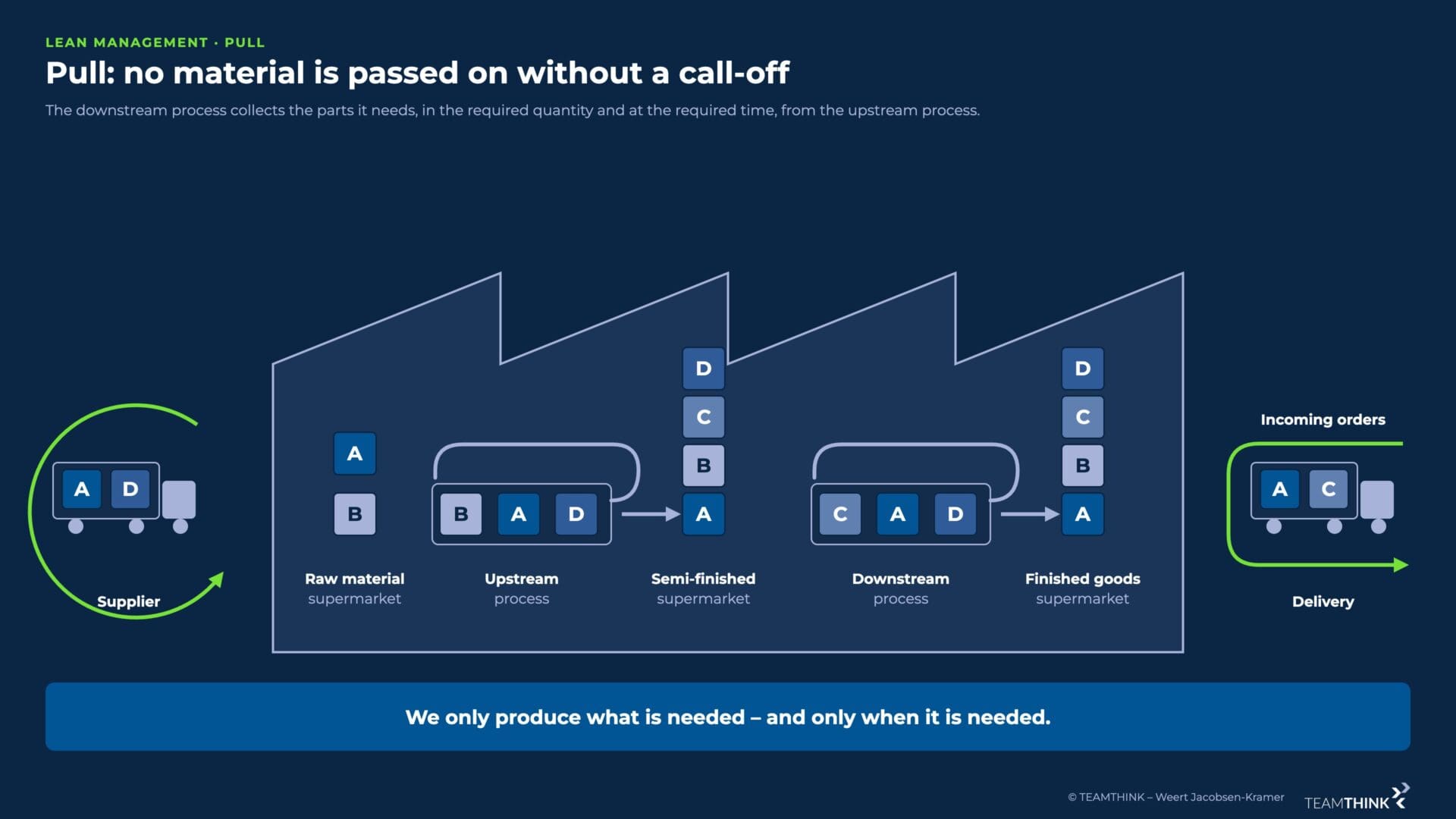
Pull production means that material is not passed on without a call-off . This is why it is also called replenishment production.
The downstream process collects the parts it needs, in the required quantity and at the required time, from the upstream process. So only what is needed is produced, and only when it is needed. Pull production is enabled by kanban systems (cards), which trigger the order “upstream” in the value stream.
Pull production enables a production process that works with minimal inventory and therefore allows a short lead time.
TEAMTHINK – specialist in lean culture change
Lean or agile transformation always goes hand in hand with a development of the leadership culture in the company.
TEAMTHINK specialises in lean and agile transformation combined with leadership culture change.
On the one hand, we support our clients on their way to operational excellence on the basis of lean & agile management.
On the other hand, we provide the necessary leadership training for culture change in the leadership team from a single source, with which our clients achieve collaborative excellence .
This gives our clients the entire transformation well coordinated from a single source.
TEAMTHINK · Operational Excellence
Where are the biggest levers in your value streams?
Since 2000, TEAMTHINK and its team of experienced consultants have been implementing lean management in production, development and indirect areas. In our on-site Quick Check, we spend two days looking at your processes and discuss the results with your management.