Which elements does an agile transformation need?
Everyone is talking about agile organization, but the question actually arises for many customers: which elements do I need for an agile transformation?
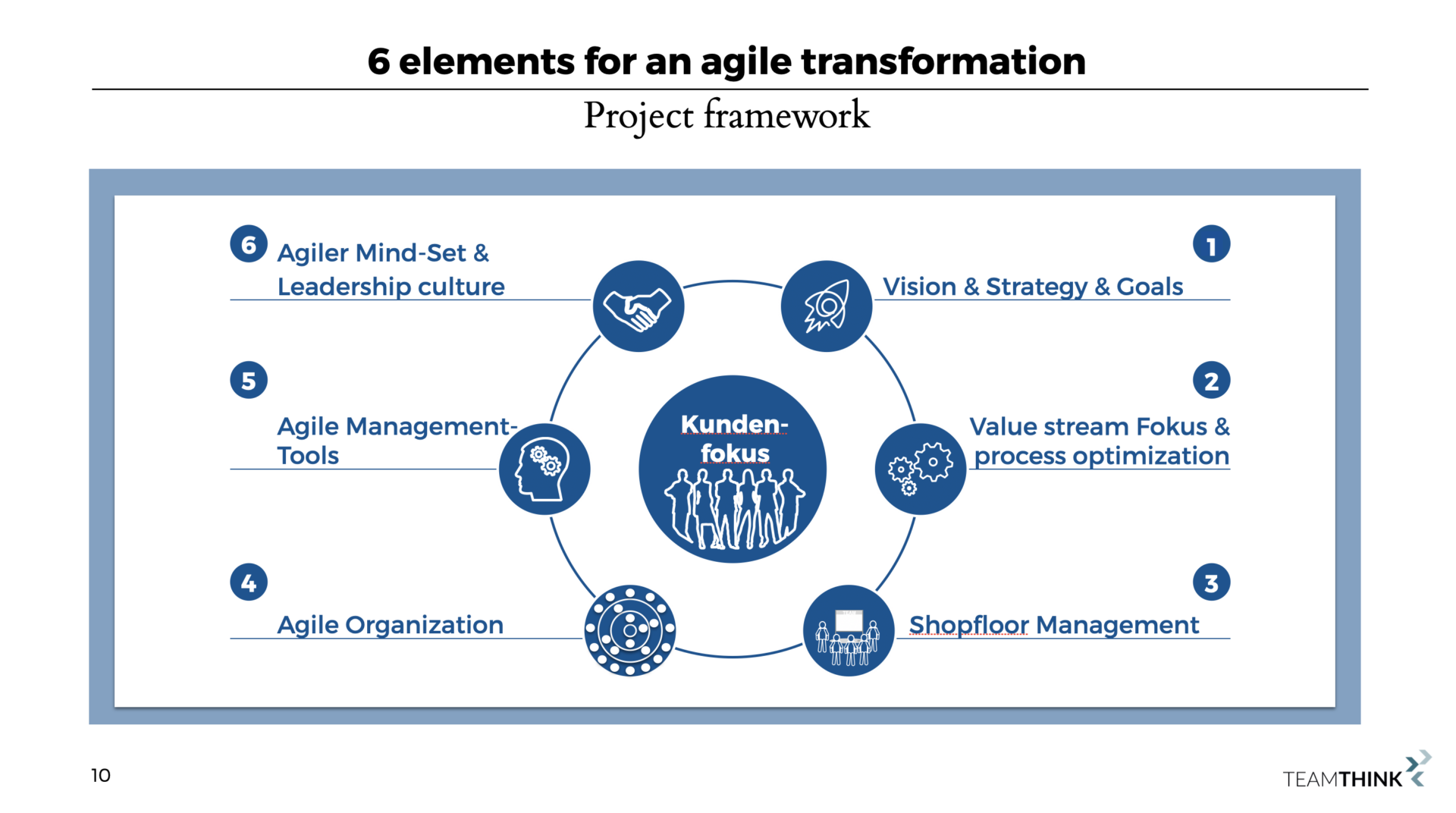
The agile transformation needs 6 central elements. It should be mentioned that these elements are mentioned in a logical order, but that the topics are mixed up in the implementation during the transformation project. The topics are therefore not processed linearly, but they are iteratively and incrementally developed over time.
1. Vision & Strategy & Goals
A good starting point is a strategy discussion in top management about the general direction of the company. A comparison between the hierarchical organization and the value stream organization as well as the agile organization is worthwhile. In the course of the discussion about the evolution of organizational models, top management develops an idea of the future strategic direction that can be described in a vision and strategy and discussed further with employees.
Contact us now!
We have more than 20 years of experience and deliver high quality consulting for your Agile, Lean or Digital Transformation.
2. Value stream focus & process optimization
In the next step, the company’s central value creation processes can be optimized along the core value streams according to the business needs of external and internal customers. In this context, the project teams involved have the opportunity to learn and try out agile project management and gain experience with it.
3. Shopfloor Management
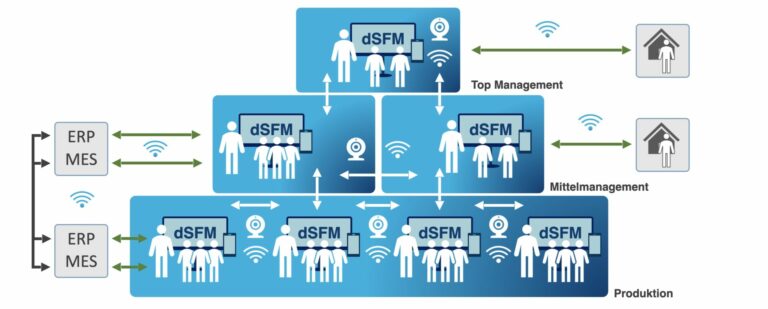
Self-management in a team needs a visualization of the relevant information in the team that the team needs for control. Shop floor management is an integral component in establishing an agile organization and is implemented piece by piece in all areas and departments of the organization during the transformation project.

4. Agile Organization
Now the time has come to specifically plan and implement the design of the agile organization. The company has gained sufficient experience with value stream focusing, agile project management, a new understanding of roles in leadership and the concept of multiple memberships in order to coordinate a start configuration of the agile organization between top management and middle management. The decision about the start configuration is made by a consent decision making process which is key to the agile organization decision making culture. Afterwards, workshops on the constitution of the self-organized circles ensure the change to the new organization.
5. Agile Management Tools
Middle management is now ready to introduce new agile management tools in the company. Above all, the method of self-targeting should be mentioned here, which has meanwhile become known under the catchphrase OKR (Objectives and Key Results). The strategy process now provides the basis for the first OKR cycle.
6. Agile Mind-Set and Leadership Culture
Over time, the employees have internalized the new management tools and the new management culture. Corresponding governance rules ensure the decision-making framework and everyone is increasingly developing an agile attitude. At some point, those involved realize: we are agile, and not just on paper, but above all in our heads!
Duration of the Transformation
The transformation into an agile organization generally takes between 18-24 months. Large companies will have to plan a longer period of time for the transformation. In general, it is also important to note that in the course of an agile transformation, it is important to carefully consider in which area or in which parts of the organization an agile transformation makes the most sense. The transformation into the agile organization is not an end in itself but always pursues the goal of increasing productivity in the company. Therefore, it is important to think carefully in advance where the need for productivity increases is greatest in the company. The transformation project should start here.