Agility is a megatrend
This interview with Weert Jacobsen-Kramer was recorded in 2017 after a talk about agile organisations. Many of its statements have since been confirmed; after further projects, we see some of them in a more nuanced way today. You will find our review at the end of the article.
Dear Weert, thank you very much for your talk about agile organisations. It sparked a lively discussion.
1. What was the central statement or message of your talk?
“My central statement is that ‘agility’ is not a fad but a metatrend, in the course of which agile tools and management methods will become permanently established in companies and organisations.
The reason is that agile methods have already proven their success very concretely ‘where the action is’. Studies, for example, clearly show that agile project management methods are superior to classic methods.
This development is comparable to the establishment of lean management (Toyota Production System) since the 1990s. Lean management has proven its thorough success in production. Today the question is no longer whether to introduce lean management, but rather at which stage of lean development a company stands.
The same trend can be observed with agility. In 10 years, people will no longer ask whether to introduce agile management, but at which stage of agility the company stands.”
2. How did the audience react, and what was the lively debate about?
“The question of whether an agile organisation can really do without management hierarchies was clearly the central point of discussion.
That is not surprising, because this is the key difference from traditional organisations. In the agile organisation, central functions of the manager are taken over by the teams themselves. Work steps and work processes are self-organised.
The traditional leadership role is called into question, sometimes even abolished completely and replaced by self-organisation based, for example, on a company constitution (holarchy/holacracy). In this system, employees can decide everything according to a defined process, even their salaries and larger investments.
For many listeners this idea is probably strange at first, because in their working lives they have mainly experienced the traditional management hierarchy.”
3. What do companies gain from becoming agile? What is the added value?
“I would like to highlight two significant advantages of agile organisations.
On the one hand, the team takes over central management and sometimes staff functions. This reduces complex and time-consuming delegation and reporting structures and cuts administrative costs.
On the other hand, employees and teams lead themselves and can decide independently on the next necessary actions. This leads to an enormous acceleration of decisions in the company.”
4. The evolution of organisational models
On the one hand you talked about the metatrend of agility in companies, and on the other hand about the fact that not all companies or organisations need agility. Who needs what? And how do these two statements fit together?
“Well, I believe it is not about establishing agility in every company at all costs. Changing the organisational culture is not an end in itself and should serve a goal.
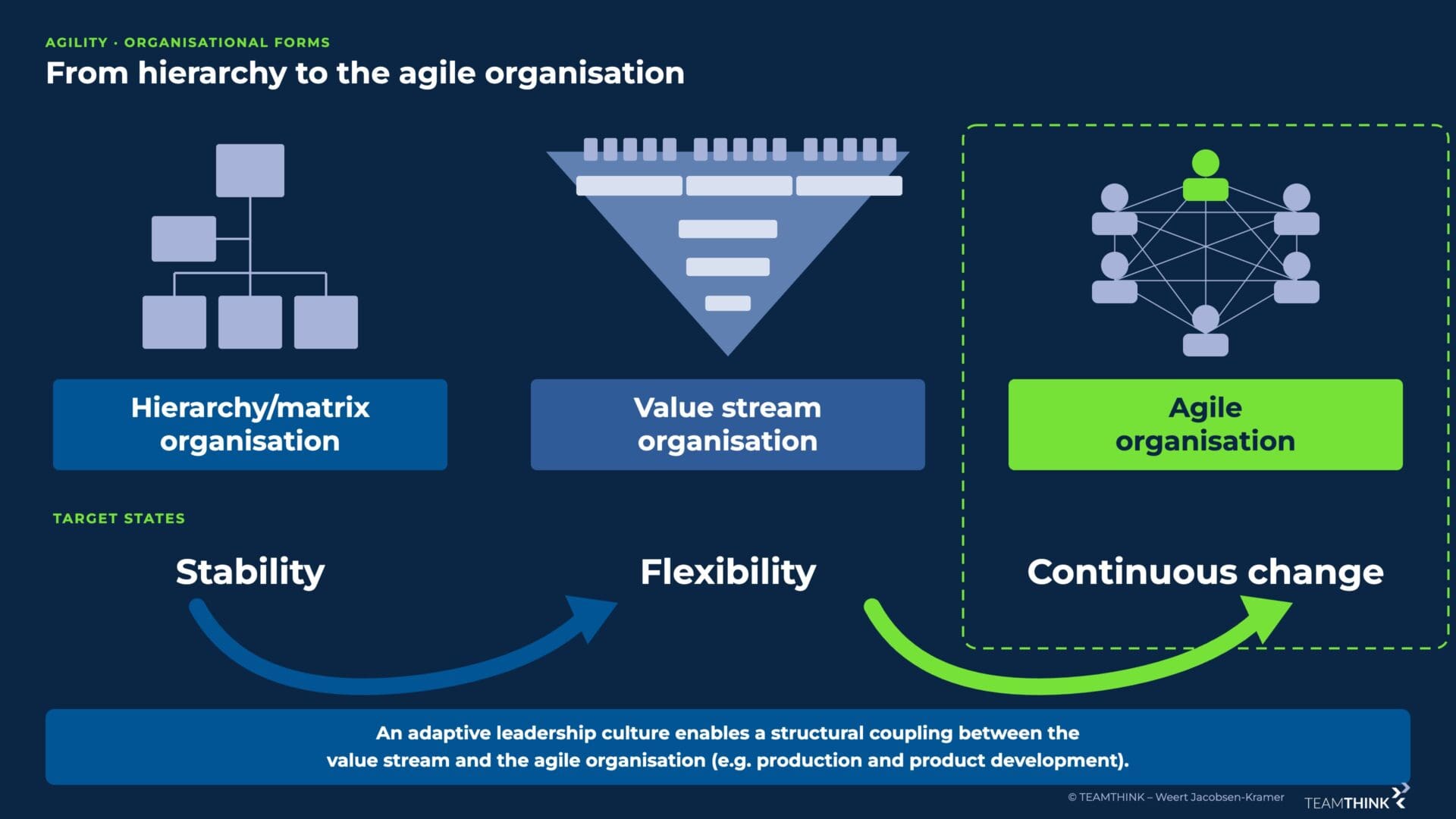
If the goal of an organisation is
* stability, the traditional management hierarchy is the right choice (e.g. in a public authority).
* flexibility, the value stream organisation (e.g. a company with lean production) is the best choice.
* constant adaptability under complex conditions, the agile organisation – e.g. for companies in software development – is the best solution.”
How does adaptability go together with stability?
There are certainly organisations or companies that need stability in some areas and a high degree of adaptability in others at the same time. How do companies reconcile the two?
“That is a good question. It is best explained with a concrete example. Let us take a typical company with production and development.
In production, the strong linking of processes in the value stream often makes it impossible to switch completely to an agile organisation. Here, a value stream organisation based on lean management principles with an ‘inverted’ management hierarchy – the manager serves the team and ultimately the value stream – is advisable.
At the same time, agile methods can achieve great productivity improvements in development, or the entire department can even be switched to agile management.
The link for this ‘structural coupling’ of two social systems, as we systems thinkers say, is the shared leadership culture. It allows these two different systems to exist side by side.
That is why I speak of leadership culture development and not of leadership development. These are two very different topics.
Leadership culture development is the big topic of the coming years.”
What are the most important success factors and the biggest obstacles??
What should companies bear in mind if they want to become agile? What are the most important success factors and the biggest obstacles?
“The biggest obstacle is the leadership attitude of the managers involved. They have lived the traditional management hierarchy so far and often find it difficult at first to develop a suitable agile leadership attitude. It is simply not easy to throw ‘old’ thinking overboard.
The key success factor is that top management or the owner has already developed an agile leadership attitude or is willing to set out on that path.”
TEAMTHINK · Transformation & Culture
Where should your company’s journey take it?
Since 2000, TEAMTHINK has been supporting transformation and culture change projects in industry. With the Future Compass, you and your leadership team develop your target picture, strategy and roadmap for the next 24 months.
In your view, what is the main lever for inspiring people about agility or convincing them of it?
“I am asked this question again and again: ‘How can I change a person’s attitude?’
The initially disappointing answer is: we cannot change a person’s attitude, just as we cannot change people in general. Many managers and even experienced consultants are not always fully aware of this. When something makes sense to people, they are willing to change themselves. That is why the agile manager leads through ‘meaning’.
Given this, there is a way to change attitudes: by questioning the world view behind the attitude, or by offering a world view that fits agility better because it creates meaning.
In my trainings and workshops we work regularly and intensively on world views, and I find that managers are both open to it and grateful for it.
On the other hand, companies want to introduce agile methods right now. Traditional management tools simply no longer deliver the necessary results. Companies today are under strong pressure to become even faster in their processes. Agility offers the right solution.”
8. In your view, how do agility and the systemic consulting approach fit together?
“In my opinion, there has never been a better time for systems thinkers in the last 20 years than right now. Agility is an absolutely central topic for systemic consulting. We are experiencing a revolution in the way we think about organisations. The terminology is changing too: it is about ‘new work’, ‘the collegially led company’ and ‘evolutionary purpose’.
Agile companies that are already very successful on the market are challenging the management paradigms of the 1980s and 1990s, the textbook knowledge of renowned management institutes and classic consulting firms.
The future belongs to the leadership paradigm that serves the understanding of natural, living, self-organised, autonomous and complex social systems. ‘Command & control’ leadership based on linear machine logic will continue to lose importance.
In principle, systemic consulting offers exactly the right mental model and methods to support companies on their way to agility.
However, this also means that systemic consulting itself will partly ‘become agile’, especially in its methods.”
9. Finally, dear Weert, one more question: what can you offer clients concretely to make their organisations and companies more agile?
“The easiest way into the topic is a 2-hour keynote talk on the ‘agile organisation’.
The next option is a two-day workshop with the management team, in which we dive deep into the topic together and already develop ideas about which aspects of the agile organisation could be relevant for the client.
Another offer is the introduction of project management methods in the company (e.g. Scrum or Kanban project management), because the advantages of the agile leadership attitude quickly become visible here.”
Weert Jacobsen-Kramer, 7 December 2017
Review 2026: what has been confirmed – and what we see differently today
- Agility has stayed. Agile methods such as sprints, team boards and OKR are part of everyday life in many industrial companies today – the metatrend has been confirmed.
- The hybrid form is winning through. A purely agile organisation is rarely the goal in industry. Value stream organisations with agile elements and hybrid project managementare successful: plan long-term, steer agilely in the short term.
- Leadership is not abolished; it changes. Line and project work best when synchronised, as in the Performance U. Self-organisation needs a clear framework.
- Getting started is more compact today. Instead of a two-hour talk, we offer 45-minute keynote talks ; and for aligning the leadership team, the Future Compass.