Compass for the Future
The Compass for the Future: The TEAMTHINK Method for Guidance During Transformation
Transformation projects rarely fail because of the strategy. They fail because no one in the room can say exactly where the organization stands, what to do next, or whether the organization even has enough momentum for the next step. This is precisely where the Future Compass comes in—a workshop format that TEAMTHINK has developed based on over 20 years of experience in Lean and Agile transformation projects.
What Is the Future Compass?
The Future Compass is a two-day workshop format for leadership teams that enables them to take stock of their current situation together, either before or during a transformation. Rather than discussing change in abstract terms, the method uses four cardinal directions, each of which poses a key leadership question—plus a question about the energy and momentum needed for change. Taken together, these five dimensions make the organization’s current state tangible.
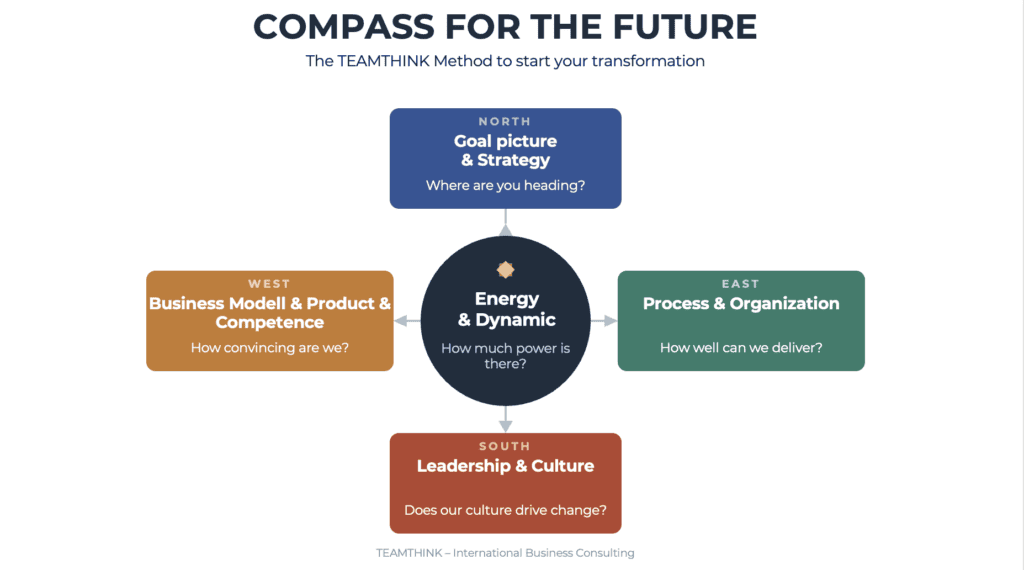
North – Vision & Strategy: What is your corporate vision? What is your corporate strategy? What are your goals for the coming years? Which strategic projects are currently important to you?
East – Processes & Organization: How efficient are your company-wide cross-functional processes? What is the state of operational excellence in your company? Is your organization positioned for the future? What potential for improvement do you see?
South – Leadership & Culture: What is the state of leadership and collaboration within the company? What potential for improvement do you see in the areas of leadership and collaboration?
West – Business Model, Products, & Competencies: How compelling is your business model? Are your products future-proof? Do you have the necessary competencies to master future challenges?
The Center – Energy & Momentum: How much energy for change does the organization currently have? Where in the organization is there positive energy for change—where are there forces of inertia—and where is there resistance?
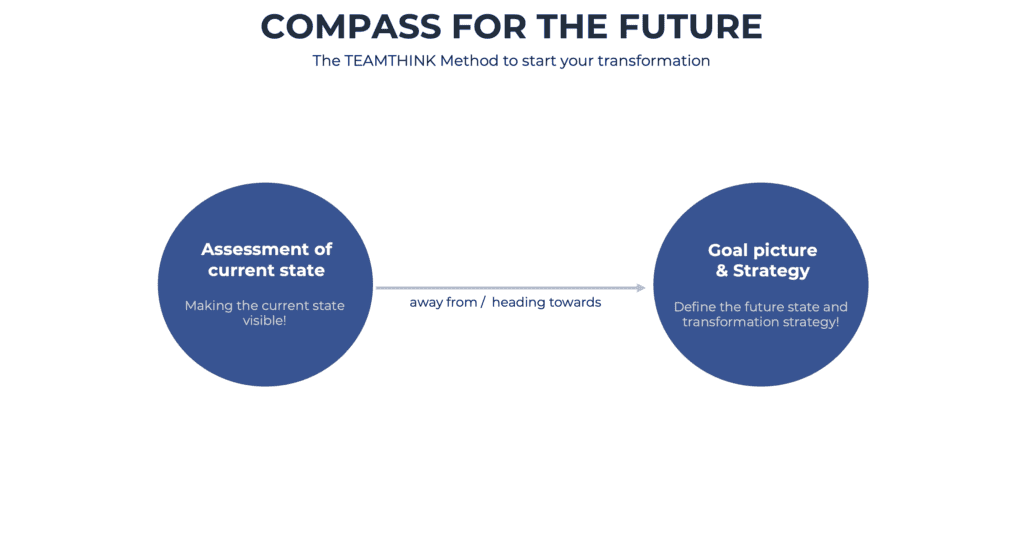
“Away from / Toward” Movement:
Together with you, we develop a picture of the current situation and identify the strengths and areas for improvement in each dimension.
We work with you to define your North Star—a clear vision distilled into just a few sentences that provides direction without prescribing every step in detail.
We then develop a transformation strategy. We set priorities and define key objectives.
Finally, we work together to define the relevant subprojects for implementing the overall strategy.
We examine the actual capacity for implementation—beyond glossy presentations and empty promises—and create a sense of optimism by developing a plan for the next 24 months.
Why This Format Works in Workshops
Four directions are just enough to actually work through in a room full of executives without the discussion getting sidetracked. At the same time, the Future Compass deliberately covers both sides of any transformation: the technical (target state, value stream) and the human (leadership, energy). This is no coincidence; rather, it follows our core belief: Lean or Agile transformation can only succeed if the introduction of new methods and a shift in leadership culture go hand in hand.
For workshops, leadership retreats, or the kickoff of a transformation project, this means that the Future Compass provides a common language and a shared vision to which different perspectives in the room can relate. This reduces the friction that otherwise arises when each leader brings their own mental model of “where we stand.”

How the Workshop Works
Preliminary Interviews: For the Future Compass, we conduct preliminary interviews with workshop participants. All four “cardinal directions” are discussed based on guiding questions. In addition, we conduct a general data analysis (numbers, data, facts) of the company.
Future Compass: The results are compiled into a report, prioritized, and translated into concrete areas of action.
Status Assessment: The final report is validated by the participants during the workshop. The team decides on priorities and key focus areas for change.
Transformation Project with Subprojects: Workshop participants define the necessary subprojects within the framework of a larger transformation project to move from the current situation toward the desired vision for the future. Depending on the complexity of the transformation, we typically identify between 8 and 12 subprojects. During the workshop, participants outline the subprojects and define the project name, project manager, and project team. The target vision, milestones, and timeline are defined.
High-Level Planning: Workshop participants develop a high-level plan covering the next 24 months.
Outcome: At the end of the workshop, the result is not an abstract strategy document, but rather a visualized assessment of the current state, a vision for the future, and the relevant projects and subprojects—including responsibilities and timelines.
The Future Compass Workshop Process
The Future Compass is part of a consulting process consisting of 7 steps.
| Step 1: | Scope Definition & Engagement |
| Step 2: | Participant Selection & Invitation |
| Step 3: | Preliminary interviews with the participants & data analysis (numbers, data, facts) of the company |
| Step 4: | Preparation of a summary of the interview results in a report |
| Step 5: | Conducting the “Future Compass” Workshop |
| Step 6: | Summary of Workshop Results (Report, Future Compass, Transformation Project—including subprojects and timelines) |
| Step 7: | Follow-Up Workshop: Kick-Off for the Transformation with all Stakeholders |
Where the Future Compass Comes In
The Future Compass proves its value primarily in two situations: at the start of a transformation project, when a leadership team has not yet found a common language for change, or in the middle of the process, when progress is noticeably stalling and it is unclear what is actually causing the problem—whether it’s the process, the expertise, the leadership, or the organization’s energy.
It does not replace an in-depth value stream analysis or cultural analysis, such as those we use in more extensive transformation projects. It serves as a quick, visual starting point that brings a leadership team together around a table and onto a shared roadmap—before the actual transformation work begins.
The Future Compass is a workshop format developed by TEAMTHINK. Learn more about our consulting approach to Lean and Agile transformation combined with leadership culture change: mail@teamthink.de or +49 4343 4962280.