Digital Transformation Office: how to make the wise pivot
Digitalisation rarely fails for lack of money – it fails for lack of steering. Many companies launch pilots, buy software and set up innovation labs, yet the initiatives run side by side, compete for the same budgets and lose sight of the core business.
Two building blocks make the difference: central steering of all transformation initiatives – the transformation office – and a smart allocation of investment budgets. Only together do they turn many individual measures into an effective transformation.
The wise pivot brings exactly these two building blocks together: the company strengthens its core business and uses it to fund the move into the new. This article shows how a transformation office plans, steers and measures this pivot.
What is a transformation office?
A transformation office is a small, effective steering unit reporting directly to management. It plans and steers all transformation initiatives as one overall programme – and directs the digital investment to where it has the greatest impact. It does two things:
- Overall programme management: it bundles projects, dependencies, resources and risks in one portfolio and creates transparency for management.
- Steering the digital investment: it helps decide how much budget goes into the efficiency of the core business, into its growth and into new business models.
A classic PMO administers projects. A transformation office is accountable for impact: it measures whether initiatives cut costs, generate growth or open up new revenue, and reallocates budgets when they do not. It also connects departments, experts and employees so that the transformation does not get stuck in silos.
The wise pivot: three horizons, one programme
The wise pivot describes the smart move into the new without neglecting the existing business. For this, Accenture surveyed around 1,440 C-level executives in 12 countries in 2018 (Make Your Wise Pivot to the New). Only around 6% of companies mastered the pivot; they first strengthened their core business and used it to fund new businesses.
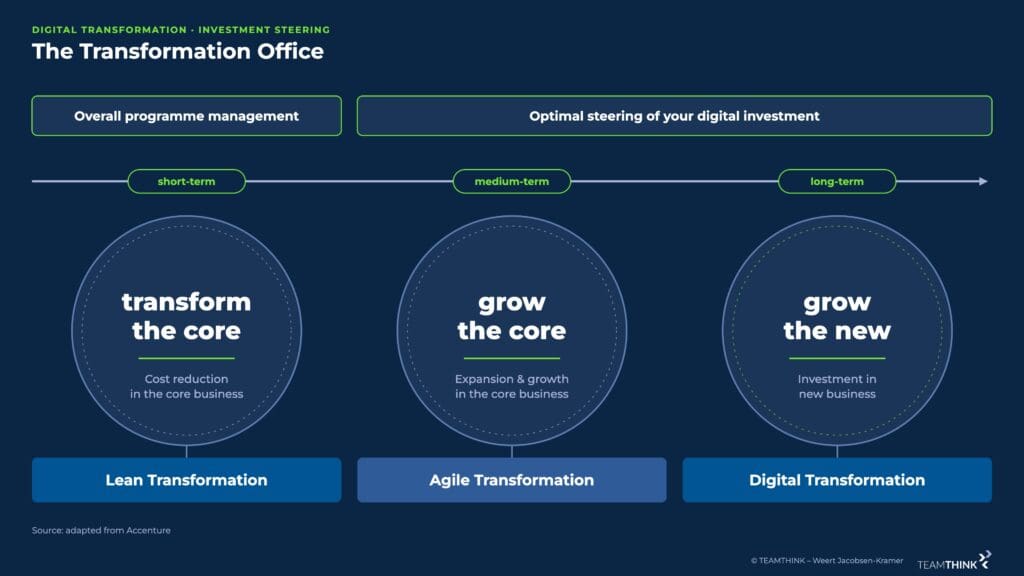
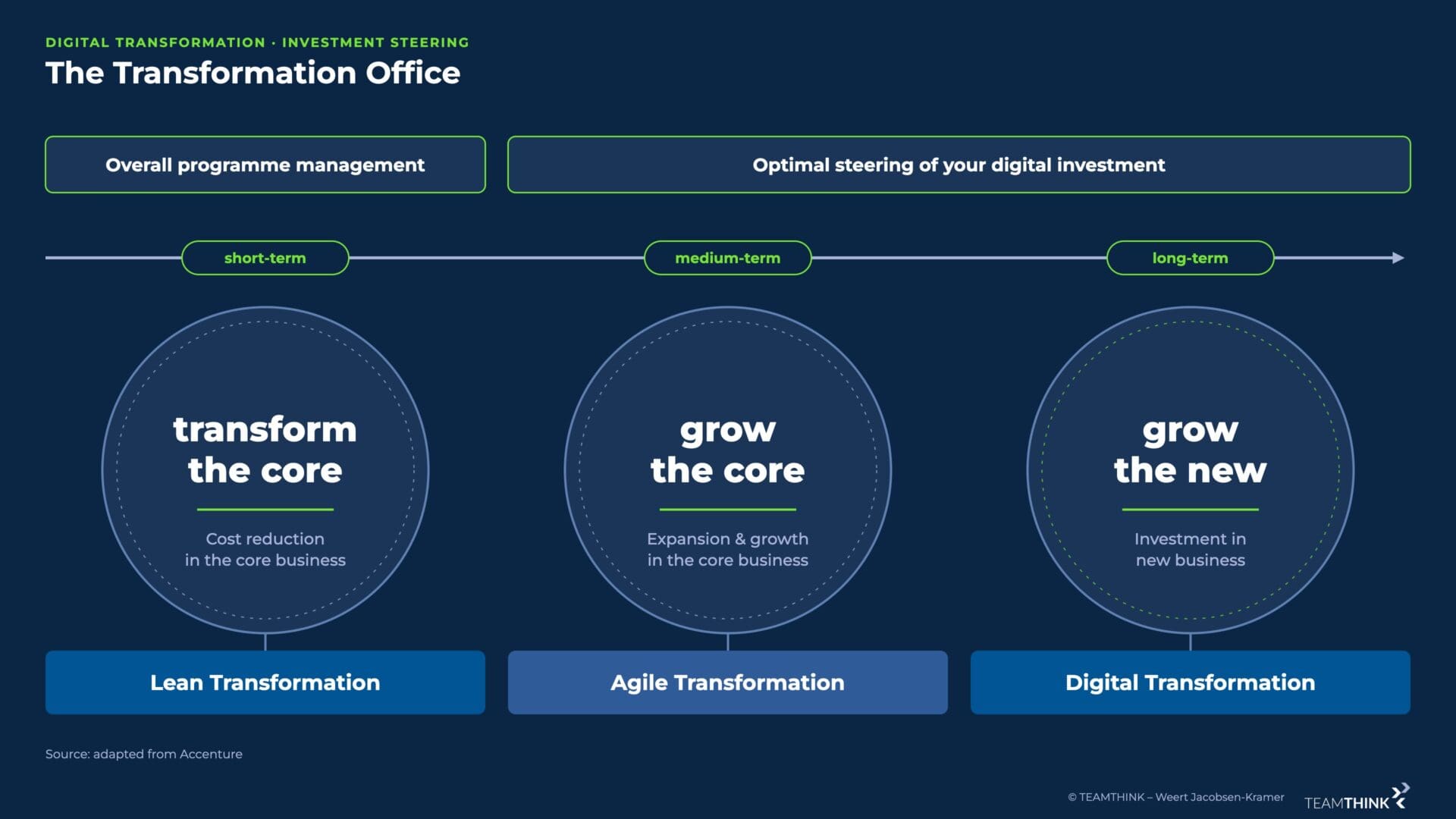
The transformation office translates this principle into three time horizons:
- Short-term – transform the core: streamline processes, eliminate waste, cut costs in the core business. The money and capacity freed up form the investment budget for the next steps.
- Medium-term – grow the core: the core business becomes faster and closer to the customer. Agile teams develop products and services further and open up new customer segments.
- Long-term – grow the new: new digital business models emerge in the cybersphere – tested with the lean startup method and steered as a portfolio to create a continuous flow of business models.
Important: the three horizons run in parallel, not one after the other. The difference lies in the weighting of the budget and the time until results show.
Smart budget allocation: the transformation funds itself
At the heart of the wise pivot is a funding cycle: savings in the core business pay for growth and new business. The transformation office makes this cycle visible and manageable.
| Horizon | Budget goal | Typical KPIs |
|---|---|---|
| transform the core | Cut costs, free up capacity | Lead time, process costs, productivity |
| grow the core | Expansion and growth in the core business | Revenue growth, customer satisfaction, time-to-market |
| grow the new | Investment in new business | Validated experiments, revenue share of new business models |
In regular portfolio reviews, the transformation office checks which initiatives are meeting their goals. What does not work is stopped; the budget flows into the most promising projects. This turns many individual projects into a steered investment portfolio.
Lean, agile, digital: three transformations as one programme
Each horizon can be matched with a transformation approach. The transformation office ensures that the three approaches interlock instead of competing with each other.
- Lean transformation (transform the core): value stream mapping, Makigami and shopfloor management make waste visible and create the efficiency gains that fund everything else.
- Agile transformation (grow the core): agile teams, OKR and self-organised circles speed up decisions and bring the core business closer to the customer. Our agile transformation benchmark project shows what this looks like in practice.
- Digital transformation (grow the new): co-creation with customers and partners, digital distribution channels and the lean startup method bring new business models to market quickly.
The order has a reason: companies with lean processes and agile teams can test and scale new business models faster. And new business models in turn change the culture of the core business.
Setting up a transformation office in 6 steps
- Clarify the mandate: management commissions the transformation office and gives it decision rights over priorities and budgets.
- Assess the starting point: all ongoing initiatives, budgets and dependencies are captured in one portfolio.
- Assign the horizons: each initiative is assigned to transform the core, grow the core or grow the new – gaps and duplications become visible.
- Define KPIs: a few measurable goals are set per horizon, such as process costs, growth or validated experiments.
- Establish a steering rhythm: fixed portfolio reviews, visualised in shopfloor management, ensure fast decisions.
- Take people along: communication, training and employee involvement turn the programme into a shared movement.
A transformation office does not have to be large. Often two to four people with a clear mandate are enough, working closely with management and the heads of department.
Conclusion
The wise pivot is not achieved through more projects but through better steering. A transformation office combines lean, agile and digital into one programme, funds the new from the core business and directs the digital investment to where it has an impact.
Expert interview: new business models in the cybersphere
“Many companies and entrepreneurs have not yet understood the full scope of digitalisation!” says Uwe Weinreich. He has been active as a digital entrepreneur since 1995 and is also a book author and consultant. In conversation with Weert Jacobsen-Kramer, he explains why the transformation office and smart budget allocation are so important for digital change.
The interview was recorded in 2020 – and is more relevant than ever. With the AI hype around ChatGPT, the full scope of digitalisation has reached the mainstream; the principles Uwe Weinreich describes still hold today.
Topics of the interview:
- Two phases of digitalisation: the first phase was the computerisation of the world, the second is the emergence of new business models in the cybersphere.
- Networked economy: companies use networks and platforms to offer their products and services.
- An opportunity for SMEs: the cybersphere opens up new target groups and business models – developed and tested with the lean startup method and in co-creation with customers and partners.
- Business model portfolio: a continuous flow of new business models instead of individual large projects.
- Four core elements of new business models: strategy, products and services, digital distribution channels and the internal change of the company.
- Digital or transformation office and smart budget allocation: cut costs in the core business, expand the core business and invest in new business – exactly the wise pivot this article describes.
Listen to the podcast: Podcast: Digitalization – New Business Models in the Cybersphere
TEAMTHINK · Since 2000
Want to move your transformation forward?
We support Lean, Agile and culture change projects in industry. In a free strategy call, we will clarify where you stand and which next step makes sense.